
Eric Ames
Carl Hagenbeck’s Empire of Entertainments
One aspect of the book will be of particular interest to American readers: the history of Wild West shows in Germany. The story of Buffalo Bill, his Wild West, and its reception in England and France is of course very well known. But the German episode is relatively unfamiliar, and much of this material remains unavailable in English.
When the Wild West arrived in Germany, around 1890, it was first received as a type of ethnographic exhibition, because that was the predominant practice and the defining category at the time. Buffalo Bill was hardly the first to exhibit Native Americans in Germany. There were many different “Indian” shows touring the country and vying for audiences throughout the 1880s. A close look at this material suggests that the story of the Wild West in Germany is one of spectatorship and its unexpected consequences for ethnographic performance. Reporting on the live display of Native Americans, commentators regularly invoked the names and works of popular writers, especially James Fenimore Cooper and his Leatherstocking Tales. To German audiences, the Wild West seemed to convert fictional characters into living tissue. Rather than preserve the traces of peoples who were supposedly either dead or on the verge of dying, as ethnographic museums claimed to do, the shows were seen as giving “life” to figures that never even existed, such as Cooper’s Natty Bumppo. What makes this move so interesting is that it was instigated by spectators, not by entertainers or publicists—who were initially surprised by and unprepared for such a creative interpretation of the shows. In Germany, the unintended effect of the Wild West, for all its claims to history and “reality,” was the vivification of a fictional universe.
From there, I go on to explore some of the ways in which Hagenbeck responded to the Wild West and its phenomenal popularity by revising his own practice. The upshot, I suggest, is a dramatic shift in ethnographic performance: from a “scientific” mode to one that was blatantly theatrical. In this mode, native participants acted out fictional roles that were literally assigned to them, and spectators, for their part, were remarkably accepting of the show’s theatricality. This is especially true of the exhibitions held between 1907 and 1914 at Hagenbeck’s Tierpark. There, dramatic performances coexisted with native villages, mountainous landscapes, and other monumental sets. The park created a fantasyland environment for live human and animal display, the sense of entering a magical world, where fictional stories of exotic adventure unfolded before the spectator’s eyes, where reality and fantasy seemed to intermingle. Hagenbeck managed to hold the line on both issues.
I hope to challenge and revise the whole idea of theme space as being an essentially American phenomenon, which begins with Disneyland and goes into other theme parks, theme restaurants, shopping malls, and so on. Theme space has a history, and it has been imagined and constructed in many different ways. In the late nineteenth century, it was defined by the wide-scale collection and physical transport of materials to the spectator, as evidenced by Hagenbeck’s live animal environments and ethnographic performances. In this case, themed environments were built with objects and bodies that had literally been imported from other parts of the globe, to be arranged, transformed, and exhibited in public. Some members of the audience were clearly aware that the experience of vicarious travel, which they found to be so exciting, was only made possible by the actual movement of the surrounding objects, animals, and people on display. The main difference between themed environments of today and their nineteenth-century predecessors is the emphasis on the signs and traces of physical presence within the space of display, as opposed to the contemporary fascination with “virtual reality.”
And yet the Hagenbeck material, which extends all the way from live animal environments and performances to early silent films, turns out to be extremely useful for addressing questions of change over time. It is the double nature of Hagenbeck’s entertainments—as devoted to both the material world of collecting and the imaginary world of storytelling—that makes it rich ground for rethinking the origin of theme space.
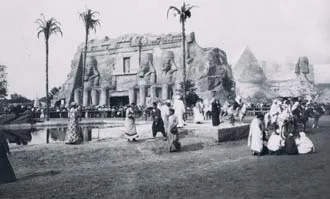
A monumental set from Hagenbeck's 1912 Egyptian Exhibition, “On the Nile.” The photo depicts the Cliff Temple of Abu Simbel, the Great Sphinx, and the Pyramids of Giza — all in one place. Spectators are visible at the foot of the temple's facade. (Courtesy of Archiv Hagenbeck, Hamburg.)
Editor: Erind Pajo
Carl Hagenbeck’s Empire of Entertainments
Eric Ames Carl Hagenbeck’s Empire of Entertainments University of Washington Press 376 pages, 8 1/2 x 10 inches ISBN 978 0295988337
Available here →May 4, 2009
20090504-ames-eric-carl-hagenbeck-empire-entertainments-3
A close-up
The rest of this thread

Eric Ames
Eric Ames is an associate professor in the Germanics Department and an adjunct in the Department of Comparative Literature at the University of Washington. He teaches courses on film history, visual culture, and German cultural studies, and is the recipient of fellowships from the National Endowment for the Humanities and the Walter Chapin Simpson Center for the Humanities. Currently, he is writing a book about the filmmaker Werner Herzog—with special focus on Herzog’s documentaries such as Grizzly Man and Encounters at the End of the World.
Pull this thread
Hagenbeck's Tierpark was a colossal outdoor panorama, and themed space began there, not with Disneyland.
Know something the rest of us don't?
Most threads on Rorotoko begin with our invitation. Any thread can begin with a proposal: you write it with the same prompts every thread answers, and we review it.
Propose a thread →