
Miles Ogborn
Global Lives
Global Lives aims to offer an introduction to global history between 1550 and 1800. Focusing on Britain’s changing relationships with the rest of the world, it sets out the contours of the forms of globalisation, or global connection, that developed across this two hundred and fifty year period. However, this is not simply a survey of the “Big Picture” history of the rise of the British empire. In order to engage readers with processes such as European settlement in North America, the slave trade, and navigation in the Pacific, Global Lives tells this history through over forty brief biographies of a range of individuals from Queen Elizabeth I to Mai, the first Polynesian to visit Britain.
This unique combination of global history and biography – the big picture and the fine-grained detail – aims to breathe some real life into what are too often thought about as abstract and anonymous historical and geographical processes – the development of trade routes, the spreading of settlement and the forging of empires.
In Global Lives, those who lived out these globalising processes are put centre stage. The history of early modern globalisation is told through the biographies of rulers and revolutionaries, the enslaved and the free, and profiteers and pirates. Each person is understood as trying to operate in the circumstances within which they found themselves. Each person is seen as trying to make a difference, for good or ill, for themselves and others. Each person, whether they travelled long distances or stayed close at home, is seen as playing a part in making this new global history and geography.
Editor: Erind Pajo
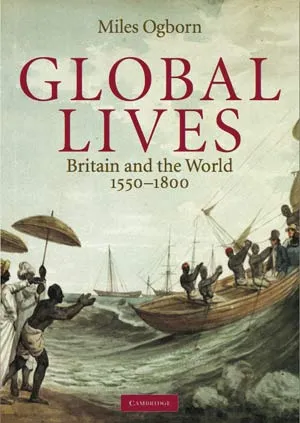
Global Lives
Miles Ogborn Global Lives: Britain and the World, 1550-1800 Cambridge University Press 368 pages, 9.6 x 6.8 inches ISBN 978 0521607186 ISBN 978 0521845014
Available here →May 8, 2009
20090508-ogborn-miles-global-lives-britain-world-1550-1-1
In a nutshell
The rest of this thread
Catherine Nash
Miles Ogborn
Miles Ogborn is Professor of Geography at Queen Mary University of London. He is the author of Spaces of Modernity: London’s Geographies, 1680-1780 (Guilford, 1998) and Indian Ink: Script and Print in the Making of the English East India Company (University of Chicago Press, 2007). He was awarded a Philip Leverhulme Prize in 2001 and has been honoured as the inaugural Distinguished Historical Geographer (2009) by the Association of American Geographers.
Pull this thread
pulls againstpulls alongside
West Africans controlled the terms of early modern trade on their own coast, including the trade in enslaved people.
Against BS · African restitution claims began in 1965 and were defeated by European museum directors, so today's debate happened forty years ago. On: The colonial relation is adequately described as domination and erasure of the colonized
Against GO · The tropics are an invention of the temperate zone, and the pineapple's circuit falsifies the ranking they carry. On: The colonial relation is adequately described as domination and erasure of the colonized
Alongside EA · Japanese colonial nostalgia for Korean folk culture turned it into the emblem of nationality for post-liberation Korea. On: The colonial relation is adequately described as domination and erasure of the colonized
Alongside MN · Palestinian citizens of Israel in the 1950s and 1960s were active participants in the Afro-Asian decolonizing world. On: The colonial relation is adequately described as domination and erasure of the colonized
Alongside AR · Palestinians built Israel, and building a country should translate into political rights within it. On: The colonial relation is adequately described as domination and erasure of the colonized
Alongside KF · Indigenous North America is a 20,000-year record of invention whose architecture stands comparison with medieval Europe's. On: The colonial relation is adequately described as domination and erasure of the colonized
Nearby RE · The 1743 Memoirs of an Unfortunate Young Nobleman, reprinted as a novel, is substantially true.
Know something the rest of us don't?
Most threads on Rorotoko begin with our invitation. Any thread can begin with a proposal: you write it with the same prompts every thread answers, and we read it.
Propose a thread →