
Gary Steiner
Animals and the Moral Community
The German philosopher Arthur Schopenhauer wrote that “in all essential respects, the animal is absolutely identical with us… The difference lies merely in the accident, the intellect, not in the substance which is the will. The world is not a piece of machinery and animals are not articles manufactured for our use.”
We today are heirs of a tradition of thinking that has asserted the fundamental superiority of human beings over non-human animals. Thus the challenge we face is how to subject some of our deepest prejudices to critical scrutiny, how to envision a new way of understanding ourselves and our relationship to non-human nature.
Chapter Five in the book takes up this challenge. Entitled “The Ideal of Cosmic Holism,” this chapter seeks to understand human being as a special form of life—a form of life that is capable of reflecting on its own nature, and hence of taking on moral responsibilities, but whose capacities for critical reflection do not render it morally superior to non-human nature. Human beings are in the unique position of being able to recognize and act on moral obligations toward animals (and perhaps toward non-sentient nature as well), even though non-human beings lack the capacity for reflection and hence lack the ability to take on reciprocal obligations toward humanity.
Our moral relationship to animals is one of stewardship: we have obligations to protect animals and to refrain from interfering with their efforts to flourish according to their natures, even though animals have no corresponding obligations toward us. The fact that for millennia we have exploited animals with little if any self-restraint is a sign not that we have any right to do so but simply that we have failed to acknowledge our place within a cosmic whole of which we are merely a part.
The horrors visited upon animals in the name of human civilization and prerogative are utterly unconscionable. The fact that animals cannot speak or write prevents them from asserting their rights; indeed, it prevents them from asserting that they have rights. The Western philosophical tradition has maintained that only rational beings can be bearers of rights—but the tradition has never offered any cogent defense of this claim. This claim appears to be nothing more than self-serving prejudice on the part of human beings. Animals and the Moral Community develops notions of cosmic justice and animal rights that can serve as the foundation for redressing a regime of animal exploitation that has gone on largely unquestioned for thousands of years.
Editor: Erind Pajo
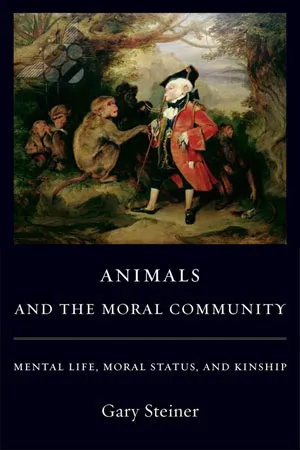
Animals and the Moral Community
Gary Steiner Animals and the Moral Community: Mental Life, Moral Status, and Kinship Cambridge University Press232 pages, 8.5 x 5.5 inches ISBN 978 0231142342
Available here →May 20, 2009
20090520-steiner-gary-animals-moral-community-mental-moral-kinship-3
A close-up
The rest of this thread

Gary Steiner
Gary Steiner is John Howard Harris Professor of Philosophy at Bucknell University. He is the author of Descartes as a Moral Thinker: Christianity, Technology, Nihilism (Prometheus/Humanity Books, 2004) and Anthropocentrism and Its Discontents: The Moral Status of Animals in the History of Western Philosophy (University of Pittsburgh Press, 2005). Steiner has degrees from the U.C.L.A., the University of California at Berkeley, and Yale University.
Pull this thread
Reason and language are irrelevant to moral status, so killing and eating animals is unjustifiable.
Know something the rest of us don't?
Most threads on Rorotoko begin with our invitation. Any thread can begin with a proposal: you write it with the same prompts every thread answers, and we review it.
Propose a thread →