
Jerry P. King
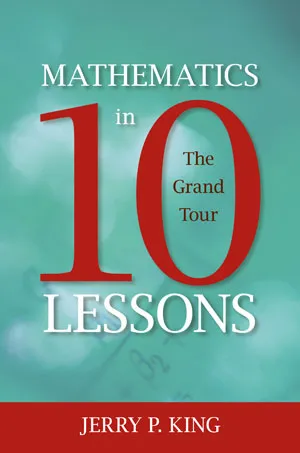
Mathematics in 10 Lessons
Mathematics in Ten Lessons is intended for an audience of humanists, where humanist is interpreted in the wide sense to mean anyone in the humanities. But, because of the way mathematics has been presented to him or her in the past, mostly as a collection of rules that sometimes work and sometimes do not, a humanist “just browsing” the book will be naturally skeptical.
He or she might overcome some of the skepticism looking quickly at page 17. On this page I write that the typical reader of Ten Lessons might well be a poet. On page 18 I assert, flatly, that “the book is truly written for poets.” At the very end of the book, on pages 377-380, I describe a similarity between mathematics and poetry. In fact, I argue that the mathematician and the poet are essentially mirror images of one another. And who lives more deeply in the humanities than does a poet?
Our browser, like most of us, will have behind experience – perhaps painful – in many mathematics courses.
Certainly, the browser had a dozen years of these courses in grades 1–12. He or she might have taken a college course or two in the subject. But it is unlikely that the browser will have thought about the nature of mathematics. Just what are mathematical objects? Where do you find them and who put them there? I address this question early on, on the pages 19-24. I assert that, like Macbeth’s dagger, mathematics lives in the mind.
Moreover I claim that mathematics is created and not discovered. Mathematics is used to explain the real world as mathematicians paint abstract pictures of pieces of the world. These pictures are made of mathematical objects like equations, or infinite series, or matrices. Mathematicians then manipulate the mathematics in these abstract models - they solve equations, sum series, invert matrices.
By this process they discover new truths.
A humanist just browsing Mathematics in Ten Lessons will immediately notice the analog between this applied mathematics process and what an impressionistic painter does when the painter selects the salient properties of real-world objects to describe abstractly on canvas, in oil paint. Or what a poet does when the poet discovers eternal truths in ordinary things, as Keats did with the Grecian Urn.C. P. Snow famously asserted that all of Western intellectual society has become separated into two groups and he claimed that between the two groups there exists a vast gulf - a gulf filled with indifference at best and, at worst, hostility and dislike. Snow called these groups Two Cultures and said that one group was composed of scientists while the other consists of literary intellectuals. We now think of them as being made of scientists and humanists, respectively.
A finer, and more accurate, description of the two cultures is that they are the M-Culture and the N-Culture. The M’s are those people who possess a certain level of mathematical sophistication and the N’s are those who do not. The M’s and the N’s cannot communicate because the M’s speak mathematics and the N’s do not. Thus it is mathematics that forms the gulf between the two cultures. But the gulf can just as easily be thought of as a bridge.
If you are an N you might live a completely happy life without ever understanding the M’s. But, if you want to understand what the M’s do then you must cross the bridge. Mathematics in Ten Lessons shows a way.
Editor: Erind Pajo
Mathematics in 10 Lessons
Jerry King Mathematics in 10 Lessons: The Grand Tour Prometheus Books 394 pages, 9 x 6 inches ISBN 978 1591026860
Available here →June 3, 2009
20090603-king-jerry-mathematics-10-lessons-grand-tour-3
A close-up
The rest of this thread

Jerry P. King
Jerry P. King is professor emeritus of mathematics and dean emeritus of the graduate school at Lehigh University, where he spent 45 years teaching mathematics and was awarded two prestigious teaching awards. He is the author of two books, The Art of Mathematics and Mathematics in 10 Lessons: The Grand Tour. He is also the author of numerous research papers in mathematics, mainly in the general area of complex analysis.
Pull this thread
Mathematics lives in the mind like Macbeth's dagger, and mathematicians make and judge it by aesthetic standards.
Know something the rest of us don't?
Most threads on Rorotoko begin with our invitation. Any thread can begin with a proposal: you write it with the same prompts every thread answers, and we review it.
Propose a thread →