
Jerry P. King
Mathematics in 10 Lessons
Galileo told us many years ago that, if you want to understand nature, you must read her book. And the book of nature, Galileo said, is written in mathematics. Without mathematics there would be no modern world - no technology, and no science beyond mere description. Go to any bookstore and choose any book that purports to explain natural phenomena. That book’s seriousness can be measured exactly by the depth of the mathematics in which it is written. If the book you chose contains little or no mathematics then you can be certain your book explains real-world phenomena only descriptively.
When scientists or engineers speak about the real world they speak in a language called mathematics. If you want to understand them you must understand a certain amount of mathematics. There is no other way. The necessity to understand mathematics is that simple, and that important.
A basic idea of Mathematics in Ten Lessons is that the best way to learn mathematics is to first learn some small piece of mathematics precisely and correctly. If you learn some part of mathematics correctly, then you can learn any part of mathematics if you must learn it or if you simply wish to learn it. Consequently, the book emphasizes the fundamental principles on which the subject is based.
You need not memorize. Learn the principles truly and well and the rest of mathematics simply flows.
Editor: Erind Pajo
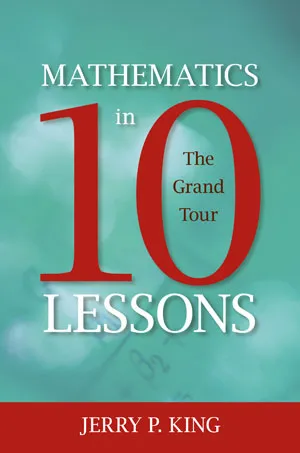
Mathematics in 10 Lessons
Jerry King Mathematics in 10 Lessons: The Grand Tour Prometheus Books 394 pages, 9 x 6 inches ISBN 978 1591026860
Available here →June 3, 2009
20090603-king-jerry-mathematics-10-lessons-grand-tour-2
The wide angle
The rest of this thread

Jerry P. King
Jerry P. King is professor emeritus of mathematics and dean emeritus of the graduate school at Lehigh University, where he spent 45 years teaching mathematics and was awarded two prestigious teaching awards. He is the author of two books, The Art of Mathematics and Mathematics in 10 Lessons: The Grand Tour. He is also the author of numerous research papers in mathematics, mainly in the general area of complex analysis.
Pull this thread
pulls againstpulls alongside
Mathematics lives in the mind like Macbeth's dagger, and mathematicians make and judge it by aesthetic standards.
Against DH · Atoms decay at unalterable rates and carry no memory, so they are better historians than any human record. On: Mathematical objects and disciplinary categories are discovered rather than made
Against WC · Salesman routing is no toy problem, an efficient algorithm for it would solve genetic sequencing and processor design too. On: Mathematical objects and disciplinary categories are discovered rather than made
Alongside BC · No natural line divides pure from adulterated food, and between the 1860s and 1906 the line moved into the laboratory. On: Mathematical objects and disciplinary categories are discovered rather than made
Alongside SB · Property has no true nature. On: Mathematical objects and disciplinary categories are discovered rather than made
Alongside CG · Meibutsu is one interlinked system of named, famous and regional things, rooted in elite connoisseurship rather than regional food. On: Mathematical objects and disciplinary categories are discovered rather than made
Alongside ES · Mathematics, even the counting numbers, is something people made up. On: Mathematical objects and disciplinary categories are discovered rather than made
Nearby CE · Numbers are an invention, not a faculty.
Know something the rest of us don't?
Most threads on Rorotoko begin with our invitation. Any thread can begin with a proposal: you write it with the same prompts every thread answers, and we review it.
Propose a thread →