
Frederick Luis Aldama
Your Brain on Latino Comics
Part of developing our taste for certain comic books—and the same applies for novels, music, art, films, and the like—is our refining of our aesthetic sensibility. This typically happens at an early age. In the case of comic books, this is partly so because, for those like myself, and in terms of pocket money, it is much more possible to buy a comic than to buy a novel or to pay to see a film. The implications are, however, foundational. It is our developing of aesthetic faculty, our “growing,” that leads us to discriminate between likes and dislikes in all aspects of everyday life and in all age groups.
In Your Brain on Latino Comics I’m particularly interested in questions such as why author/artists do know that a bold faced word is louder than a non bold-faced word. Why do we imagine movement in the spaces (gutters) between the comics as well as within the panels proper? Why do we each have our own tastes in terms of certain styles of writing and drawing?
The book turns to advances in the brain sciences to give more formal expression to development of a taste faculty, as expressed in the likes and dislikes of Latino comic books, and also to a deeper understanding of what we do, and how we imagine, when consuming them.

As the serialized story of La Maggie unfolds, our brain has already mapped the verbal narrator’s past-tense, first-person voice to the visual narrator’s focus on the character Maggie. And here things begin to get interesting. The visual narrator can describe Maggie—facial expression, gesture, behavior—in ways that emphasize or conflict with the textual—the verbal narrator's voice. One can depict happiness while the other describes frustration; one comfort, and the other paranoia. In such cases, Hernandez challenges—even plays havoc with—the reader’s cognitive schemas that work to infer inner state from outward gesture, that allow one to determine a state of pleasure or contentment from a smile.
Editor: Erind Pajo
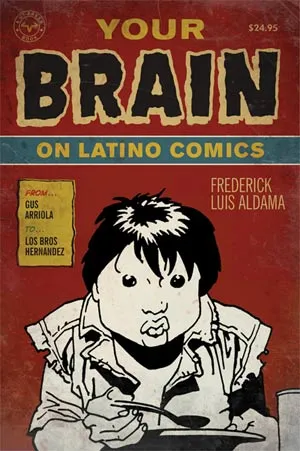
Your Brain on Latino Comics
Frederick Luis Aldama Your Brain on Latino Comics: From Gus Arriola to Los Bros Hernandez University of Texas Press 320 pages, 9 x 6 inches ISBN 978 0292719347 ISBN 978 0292719736
Available here →June 10, 2009
20090610-luis-frederick-aldama-your-brain-on-latino-comics-2
The wide angle
The rest of this thread

Melissa Soave
Frederick Luis Aldama
Before becoming a professor at Ohio State University, Frederick Luis Aldama (née Luis Federico Aldama) was born in 1969 in Mexico City to a Mexico-City born and bred chilango papa and a Guatemalan-Irish American mama. In a bizarre series of mishaps, he ended up growing up in and around Sacramento, California, and London, England, before going to UC Berkeley (B.A.) and then Stanford (Ph.D.). Today, he uses the tools of narrative theory and cognitive science in his teaching and scholarship on Latino and Postcolonial literature, art, music, film, and comic books. He is the author and editor of nine books, series editor of “Cognitive Approaches to Literature and Culture” with the University of Texas Press, and Director of Latino Studies at Ohio State University.
Pull this thread
Making a good comic about Latinos is a matter of responsibility to the story rather than blood quantum.
Know something the rest of us don't?
Most threads on Rorotoko begin with our invitation. Any thread can begin with a proposal: you write it with the same prompts every thread answers, and we review it.
Propose a thread →