
Alan C. Braddock
Thomas Eakins and the Cultures of Modernity
My book is about a historic change that occurred a century ago in the way people view human differences, illustrated through the work and life of a major artist. Today, we routinely use the word “cultures” to describe complex bodies of human behavior, or customs, formed by groups of people through social interaction over time. Nowadays, one’s “culture” is an important part of one’s identity. Because we recognize that any human being can potentially learn any human behavior, though, we also acknowledge that cultures are not etched in stone. Indeed, they can change, especially in our interconnected global community where people move frequently and communicate instantaneously.
Using the word “cultures” in this plural, changing sense only became widespread in the early twentieth century, after anthropologists Ruth Benedict and Margaret Mead (students of Franz Boas at Columbia) popularized the term in the 1920s and 1930s. Before then, most people viewed human group behavior differently. They saw the behavior of different groups as “natural”—ostensibly determined by “race,” impervious to change regardless of nationality, environment, gender, and class. Most educated people today view human groups more as evolving social entities, or “cultures.” Historians of anthropology consider the emergence of the concept of “cultures” in the twentieth century to be a major watershed, distinguishing modern from pre-modern ways of understanding human behavior. The modern concept of “cultures” has played a central role in challenging racism and biological determinism, because it acknowledges the fundamental capacity of all human beings to learn and exchange virtually any pattern of human behavior.
Thomas Eakins and the Cultures of Modernity situates an important American artist in relation to that watershed development. Whereas many art historians have attributed a modern perception of “cultures” to Eakins, my book demonstrates that the artist – who died in 1916 – did not use that term and could not have perceived human differences like a modern anthropologist. Rather, Eakins’s realistic portrayals of diverse groups of people – Spanish street performers, African Americans, southern European immigrants, Anglo-American scientists – embodied a pre-modern worldview, which confused “race” with social behavior. Yet, Eakins’s struggle to visualize human diversity amid the changing demographics and dislocating forces of his day – mass immigration, tourism, commercial publishing, and ethnographic museums – illuminates American art on the threshold of the twentieth-century concept of “cultures” in plural.
Editor: Erind Pajo
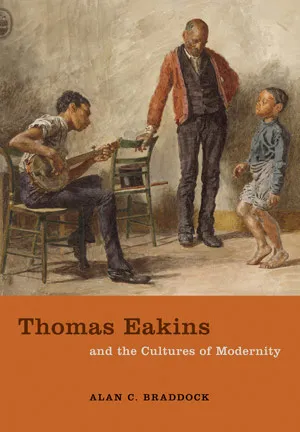
Thomas Eakins and the Cultures of Modernity
Alan C. Braddock Thomas Eakins and the Cultures of Modernity University of California Press 304 pages, 10 x 7 inches ISBN 978 0520255203
Available here →June 17, 2009
20090617-braddock-alan-thomas-eakins-cultures-modernity-1-1
In a nutshell
The rest of this thread
.webp)
Karen Sherry, 2005
Alan C. Braddock
Alan Braddock is an Assistant Professor of Art History at Temple University in Philadelphia, where he teaches courses in the history of American art and visual culture from the colonial period to the present. Later this year, the University of Alabama Press will release A Keener Perception: Ecocritical Studies in American Art History, an interdisciplinary collection of essays co-edited by him and Christoph Irmscher, a member of the English Department at Indiana University. Braddock and Irmscher also have been awarded a grant from the National Endowment for the Humanities to direct a Summer Institute on “Picturing John James Audubon” at Indiana University in July 2009. In 2006-2007, Braddock was a faculty fellow-in-residence at Harvard University’s Charles Warren Center for Studies in American History, working on his book-in-progress Gun Vision: The Ballistic Imagination in American Art from Homer to O’Keeffe, which explores the relationship between art and arms, seeing and shooting, in the United States between the Civil War and World War I.
Pull this thread
Thomas Eakins pictured human difference through a pre-modern view that confused race with behavior.
Know something the rest of us don't?
Most threads on Rorotoko begin with our invitation. Any thread can begin with a proposal: you write it with the same prompts every thread answers, and we review it.
Propose a thread →