
Alan C. Braddock
Thomas Eakins and the Cultures of Modernity
I would like to highlight the subsections on “Indian Portraits” and “Zuni Perspectives,” in Chapter 3 (pages 191-212 in the book). On those pages, I discuss a remarkable 1895 portrait by Eakins depicting the anthropologist Frank Hamilton Cushing, who had spent 1879 to 1884 doing groundbreaking ethnographic fieldwork for the Smithsonian Institution at the Native American community of Zuni, an ancient pueblo in the New Mexico territory. In an unprecedented case of scientific immersion, Cushing became a member of the Zuni tribe by shedding his Anglo clothes, learning the native language, and going through a physically painful process of initiation (some have suggested he even killed a Navajo enemy as part of the process). Eventually, Cushing attained the status of a Zuni War Priest, which gave him intimate knowledge of tribal lore and social structures – information that he communicated to scientists in Washington, D.C. Typifying his complex persona, Cushing helped the Zuni fight unscrupulous Anglo real estate developers who wanted to steal their land, yet he himself stole sacred artifacts from tribal shrines without permission.
Although Cushing’s fascinating personal story is well known to historians of anthropology, the Eakins portrait provides an equally interesting artistic case study in the pre-modern perception of “cultures.” Eakins met Cushing in 1895 when the anthropologist happened to be in Philadelphia seeking medical attention at the University of Pennsylvania. The two men immediately became friends and set to work converting Eakins’s Philadelphia studio into a ceremonial Zuni kiva (a traditional private pueblo religious space), complete with wood-burning altar and other “authentic” paraphernalia. Cushing then dressed as a Zuni War Priest and posed for the artist, who later described the anthropologist as shown “performing an incantation” in the portrait.
Leveraging the aesthetic value of secret Native knowledge and artifacts, Eakins and Cushing conspired in performing a version of Zuni customs. But the resulting portrait was more a celebration of their professional achievement than a careful exploration of tribal “culture.” As I argue, their effort seems kind of funny and ridiculous on one level, but it also epitomizes the intrusive representation of Native American communities by pre-modern social-evolutionary artists and anthropologists. Compared to many Anglo-American professionals of their generation, Eakins and Cushing were tolerant about human diversity. They were sympathetic to people whose customs were different from their own. But Eakins and Cushing were a far cry from cultural anthropologists of our time in terms of sensitivity.
While I was doing research for my book back in 2004, I visited the Zuni myself and met with members of the tribal council to get their input about Eakins’s Cushing portrait. When I showed a reproduction of it, some rolled their eyes in disgust, explaining to me that Zuni War Priests are not supposed to parade private ceremonial knowledge so boastfully in public. From the council’s point of view, Eakins and Cushing had betrayed Zuni religious sanctity and thereby demonstrated a gross misunderstanding of tribal “culture.” I then asked the council if they would prefer that I omit a reproduction of the portrait from my book. Recognizing that censoring such images is very difficult today, they simply asked me to register their distaste for the portrait. So I did. As a way of providing another Zuni perspective, I reproduced a picture by the late twentieth-century Zuni artist, Phil Hughte, lampooning the self-aggrandizing tendencies of Cushing and, by extension, those of Eakins as well. In addition to providing a further example of Eakins’s pre-modern perspective, this section makes a case for approaching art history in a more ethical, interdisciplinary way.
I have tried to make this book speak to wider ethical and historical concerns beyond the discipline of art history, as it has typically been conceived. My book also speaks to the burgeoning fields of environmental history and “ecocriticism,” which are a new interest of mine. In Chapter 2, for example, I examine Eakins’s pictures of rowing and other aspects of outdoor aquatic life around Philadelphia in relation to the city’s water pollution crisis of the same period, which art historians had neglected until now.
Because Eakins is such a canonical figure in the history of American art, scholars have tended to treat him either hagiographically – as if he were a kind of saint. Or, more recently, some have been preoccupied with revealing sensational hidden truths about Eakins’s psychology and sexuality. My book avoids both hagiography and sensationalism by treating Eakins historically, specifically by inserting him into a number of previously overlooked material contexts, all of which illuminate his pre-modern understanding of “cultures.”
Editor: Erind Pajo
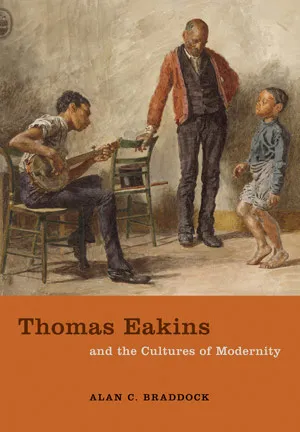
Thomas Eakins and the Cultures of Modernity
Alan C. Braddock Thomas Eakins and the Cultures of Modernity University of California Press 304 pages, 10 x 7 inches ISBN 978 0520255203
Available here →June 17, 2009
20090617-braddock-alan-thomas-eakins-cultures-modernity-3
A close-up
The rest of this thread
.webp)
Karen Sherry, 2005
Alan C. Braddock
Alan Braddock is an Assistant Professor of Art History at Temple University in Philadelphia, where he teaches courses in the history of American art and visual culture from the colonial period to the present. Later this year, the University of Alabama Press will release A Keener Perception: Ecocritical Studies in American Art History, an interdisciplinary collection of essays co-edited by him and Christoph Irmscher, a member of the English Department at Indiana University. Braddock and Irmscher also have been awarded a grant from the National Endowment for the Humanities to direct a Summer Institute on “Picturing John James Audubon” at Indiana University in July 2009. In 2006-2007, Braddock was a faculty fellow-in-residence at Harvard University’s Charles Warren Center for Studies in American History, working on his book-in-progress Gun Vision: The Ballistic Imagination in American Art from Homer to O’Keeffe, which explores the relationship between art and arms, seeing and shooting, in the United States between the Civil War and World War I.
Pull this thread
Eakins, dead in 1916, could not have perceived human difference the way a modern anthropologist does.
Know something the rest of us don't?
Most threads on Rorotoko begin with our invitation. Any thread can begin with a proposal: you write it with the same prompts every thread answers, and we review it.
Propose a thread →