
Ann Marie Stock
On Location in Cuba
In Cuba, the prominence of culture and its centrality to political and economic forces can surprise those unfamiliar with it. I recall one consulting trip early in this century, when our delegation was invited to the Presidential Palace for dinner with Fidel Castro and several members of his cabinet. As we milled about informally, the discussion ranged from golf games to the Gulf War, and included Cuban films and Disney cartoons.
One U.S. visitor, impressed by Castro’s knowledge on a wide array of subjects, asked the then Commander-in-Chief how much time he devoted to politics and how much to culture. The response was immediate and unequivocal: “In Cuba, these two cannot be separated. Culture and politics are one in the same.”
To track the experiences of several filmmakers and developments in the audiovisual sphere is, then, to explore broader cultural, political and economic issues.
On Location in Cuba acknowledges and interrogates this convergence so as to make sense of this recent time of accelerated transformation on the island.
The book tracks the transformation of a national cinema into a transnational audiovisual practice—one emanating from new technologies, straddling a series of geopolitical and formal borders, financed by multinational capital, and directed at consumers around the world. Whereas global processes often obliterate “local” cultural expression, this study demonstrates how culture workers—filmmakers here—have activated global processes and transnational linkages in order to sustain, strengthen and reshape national identity.
Cuban identity, once crafted by the revolutionary collective, has become more of a “coproduction,” growing out of the collaboration among actors working both within and outside the state apparatus. No longer does “Cubanness” emanate primarily from island institutions; instead, it emerges from the mediation between state actors and individuals, oftentimes aligned with international and non-governmental organizations based outside Cuba.
And this marks a significant change. What results is a sense of national identity that retains Cuba’s socialist principles of equality, social justice and solidarity while integrating the emerging values of individualism.
I traveled to Cuba for the first time in 1989 and have been back more than 50 times since. As a graduate student attending the International Festival of New Latin American Cinema in Havana, I was amazed by the films and exhilarated by the access I had to their creators. Over the years I continued to participate in this Festival, and stepped up my collaboration with Cuba to include designing and leading study programs, consulting for U.S. foundations and NGOs, and participating in a variety of conferences and cultural events on the island. All the while, I documented Cuba’s changing cinema tradition.
Cuban films today are increasingly made by young people “in the streets”—that is to say working outside of state channels. When I first landed in Cuba, making a film required truckloads of equipment, a crew of hundreds, and large sums of money. Today it can be managed with a handheld camera and personal computer, a few friends, and a fist full of fulas. An endeavor once centralized in the national film institute has given way to decentralized audiovisual production.
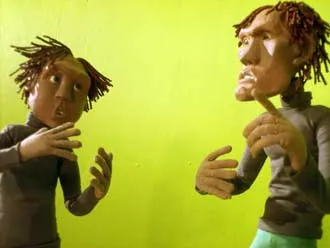
Fragment from an animation by Yurina Luis Naranjo, reproduced in the book on page 140
Editor: Erind Pajo
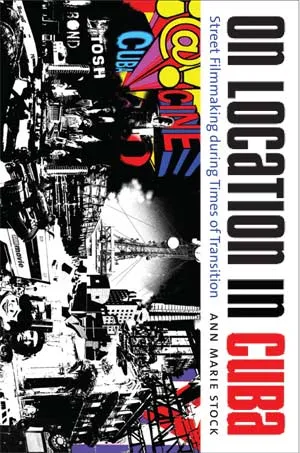
On Location in Cuba
Ann Marie Stock On Location in Cuba: Street Filmmaking during Times of Transition University of North Carolina Press 320 pages, 9 x 6 inches ISBN 978 0807859407
Available here →July 6, 2009
20090706-stock-ann-marie-on-location-in-cuba-street-filmmaking-transition-957df-2
The wide angle
The rest of this thread
.webp)
M. Troy Davis
Ann Marie Stock
Ann Marie Stock is an Associate Profesor of Hispanic Studies and Film Studies at the College of William & Mary in Virginia. Dr. Stock is the editor of Framing Latin American Cinema: Contemporary Critical Perspectives and author of numerous essays on visual culture and identity, especially in the context of Latin American cinema. As the Founding Director of the non-profit initiative Cuban Cinema Classics, Dr. Stock disseminates Cuban documentaries in the U.S. She also serves as a member of the executive committee of the Havana Film Festival of New York, and regularly participates as a juror for such film events as the Sundance Festival and Cinergia.
Pull this thread
Cuban filmmakers used global tools to reshape national identity rather than lose it.
Know something the rest of us don't?
Most threads on Rorotoko begin with our invitation. Any thread can begin with a proposal: you write it with the same prompts every thread answers, and we review it.
Propose a thread →