
Ken Alder
The Lie Detectors
I am a historian of science, but rather than focus on the achievements of great thinkers—Darwin’s theory of natural selection, say, or Einstein’s theory of relativity—I am interested in the science and technology of ordinary things.
I think that one of the most important public roles of the historian is to reveal how seemingly settled features of our contemporary world have emerged out of passionate debates whose outcome was by no means certain. Tracing these contingent pathways to the present can help us imagine how “things might be different.” For my part, I am particularly interested in the history of measurement, often considered one of our most banal and unproblematic activities. Yet to measure is to assign value. That is why the scale is an emblem of justice. Measuring is an intrinsically moral act.
My previous book, The Measure of All Things, traced the origins of the metric system, showing how the standardized measures shaped the way that ordinary people calculated their best interest in the marketplace, and how scientists themselves reconceived what it meant to err.
In The Lie Detectors I take on a technology closer to home. This technique—banal in its science, but fantastical in its claims—purports to assess a person’s veracity on the basis of bodily measurements so routine they can be turned over to a machine.
Turning the judgment of truth-telling over to a machine constituted the principal appeal of the technique in America. Like two other early-twentieth-century innovations of American applied psychology—the IQ test and Frederick Taylor’s program of scientific management—the lie detector promised to resolve one of our most contentious social problems by the application of disinterested science. But it is here that Larson and Keeler parted company—and where I distinguish between the formal ideals of justice and justice’s informal practices.
Keeler cultivated the fasade that his subjects were being judged by his polygraph machine, a piece of hardware he had patented as the “first” lie detector. In practice, however, Keeler’s greatest innovation was the creation of a set of questioning techniques (call them the “software” of lie detection) that induced his subjects to confess, which was, after all, the only form of lie detector evidence allowed in court. (I detail some of these interrogation “tricks” in my book.)Keeler’s techniques worked. In my research I uncovered surveys taken in the 1930s showing that Keeler and his disciples were able to get confession rates of 60 per cent when they accused subjects of lying. (Whether those confessions were true is another question.) In a sense, Keeler transformed the lie detector into a kind of technological placebo—effective largely to the extent it was believed.
The one exception in these surveys was the 6 per cent confession rate obtained by the Indiana State Police. Here, however, the examiner had been trained by Larson.
Unlike Keeler, John Larson ordered his disciples never to “bluff” confessions from their suspects. A noble sentiment, perhaps, but Keeler’s form of bluffing was more compatible with the form of plea-bargaining then becoming the norm in criminal justice. Today, the lie detector plays a hidden role in many of the 90 percent of criminal convictions resolved through plea bargaining. Behind its public façade of disinterestedness, American justice often plays out like a game of bluff and bluster—just like the lie detector. Keeler went on in the 1930s to sell corporate managers on deploying this same game of bluff and bluster to gauge the loyalty of their employees. And in the 1940s he sold the U.S. government on the technique to vet workers in national security—including all 18,000 residents of Oak Ridge, Tennessee, the town where uranium was being processed for nuclear bombs.
In the McCarthy era, the lie detector was used to “out” homosexuals in the civil service. And in the years since, a parade of public figures have voluntarily gone on the machine to “prove” their honesty to the public. Anita Hill took the test. So did a bunch of the Watergate crowd. Everything depended, of course, on who conducted the test—and to what end.
In other words, the lie detector is not so much a functional technology, as a mirror we hold up to ourselves in different settings. I chose to write a history of this banal, yet fantastical device because it seemed to me to serve as a kind of “placebo test” that we Americans have been administering to ourselves during the past century. It is a test that asks: What do we believe?
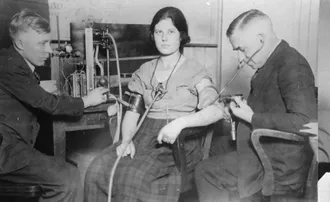
In 1921 John Larson was the first person to rig a device to continuously record the blood pressure and breathing depth of subjects while they answered “yes” or “no” to alternating relevant and irrelevant questions. Thus, the lie detector. Larson soon found the ideal experimental set-up to test his technique: a theft in a college sorority. The College Hall case not only demonstrated that the lie detector might be used to extract a confession; it also won Larson his bride—he married the victim of the theft. Here, Larson (left) and Vollmer test a Berkeley undergraduate on Larson’s first machine, currently held by the Smithsonian Institution. (Courtesy of Berkeley Police Department Historical Society.)
Editor: Erind Pajo
The Lie Detectors
Ken Alder The Lie Detectors: The History of an American Obsession Bison Books 368 pages, 9 x 6 inches ISBN 978 0803224599
Available here →July 13, 2009
20090713-alder-ken-lie-detectors-history-american-obsession-2
The wide angle
The rest of this thread

Northwestern University
Ken Alder
Ken Alder was born under the sign of Sputnik in Berkeley, California and has spent his career studying scientific change in its social and political context. He teaches history at Northwestern University, where he is the Milton H. Wilson Professor in the Humanities. His previous book, The Measure of All Things: The Seven-Year Odyssey and Hidden Error that Transformed the World (Free Press, 2002) won several prizes, was cited as a best book of the year by the New York Times and the Economist, and was translated into thirteen languages. He is also a novelist.
Pull this thread
The lie detector has survived eighty years of scientific refutation because it was never science.
Know something the rest of us don't?
Most threads on Rorotoko begin with our invitation. Any thread can begin with a proposal: you write it with the same prompts every thread answers, and we review it.
Propose a thread →