
Ken Alder
The Lie Detectors
For Keeler’s placebo strategy to succeed—both for him to sell his services and to make the lie detector effective—he had to drum up publicity. Hence, my book zooms in on the way the lie detector has been portrayed in popular culture. This is a colorful tale of comic books and science fiction.
Keeler’s most influential disciple was neither a cop nor a prosecutor, but the cartoonist Chester Gould, the creator Dick Tracy and a student of Keeler’s at the crime lab he helped found at Northwestern University. In fact Tracy was based on a composite portrait of Keeler’s colleagues in the lab. Square-jawed and incorruptible, Dick Tracy deployed scientific methods—especially the lie detector—as a bulwark against “political fix and corruption.”
And yet it was William Moulton Marston—a third, rival “inventor” of the lie detector—who did the most to lodge the device in the American popular imagination.
In 1929, William Moulton Marston invited the press to New York’s Embassy Theater to watch while he used the machine to compare the reactions of three starlets while they viewed a romantic film. On this basis, Universal Studios hired him to vet screenplays for emotional content. Then in the late 1930s Marston was invited onto the board at All-American comics to appease critics worried about the emotional impact of comics on kids.
Once inside, he created the cartoon character Wonder Woman, endowing her not only with a truth lasso, but with many subplots involving the lie detector.
Marston lasted only one year at Universal. When, in 1931, the studio was preparing to release Frankenstein—a movie expected to spur calls for censorship—the producers called on Keeler to hook up two undergraduates to his lie detector and watch a pre-release version of the film. As the resurrected Monster and the young bodies seated in the darkness shuddered together, Keeler used his machine to record the connection of sympathy and horror that was the physiological index of the film’s capacity to suspend disbelief and bring the monster to life. On the basis of Keeler’s report, the film edits were fine-tuned prior to release.
This was the lie detector deployed as a gauge of emotional honesty—and of course it drummed up further publicity for the machine. Ever since the 1950s, the lie detector has frequently been made the “star” of television shows that purport to expose the truth.
It would be comforting to think that science could sanitize the messy business of extracting reliable information from resistant human beings. Who doesn’t want justice to be swift, sure, and fair? But though promising objectivity, the lie detector has actually thrived on its opposite: gamesmanship in justice, intimidation in the workplace, deterrence in national security, and theatrics in politics.
Keeler became an alcoholic and died young and personally embittered, though at the height of his public success; his version of the technique had become “our” American lie detector. Larson died soon after, an equally embittered man, horrified by what Keeler had wrought. “Beyond my expectation,” Larson wrote shortly before his death, “thru uncontrollable factors, this scientific investigation became for practical purposes a Frankenstein’s monster, which I have spent over 40 years in combatting.”
Over the course of the past century, hundreds of polygraph studies have been analyzed by eminent scientific analysts.
They have concluded that the techniques of lie detection do not pass scientific muster. Yet lie detection lives on.
In the past few years, a number of private firms have begun to flog new forms of lie detection, such as EEG machines and fMRI scans, which gauge honesty based on the measurement of relative activity in different parts of the brain. Yet these techniques suffer many of the ambiguities of old-style polygraphs. So far they have only been tested in labs and on a handful of subjects, and they depend entirely on the subject’s cooperation. They also presume that deception comes in only one cognitive style, whereas, as Montaigne observed four centuries ago, “the reverse side of the truth has a hundred thousand shapes and no defined limits.”
Perhaps the lie detector cannot be killed by science because its habitat is not the laboratory or the court-room, but newsprint, comic books, television, and political theater. The lie detector performs a role that is less akin to science than to poker, America’s national game. After all, the technique doesn’t so much indicate whether the subject is telling the truth, but rather whether the subject feels he is telling the truth. So long as it draws its life from our fear and hopes, and so long as it feels like the truth, lie detection will live on.
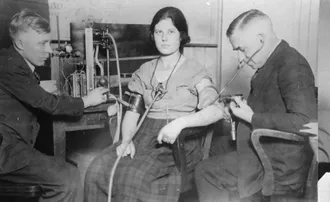
In 1921 John Larson was the first person to rig a device to continuously record the blood pressure and breathing depth of subjects while they answered “yes” or “no” to alternating relevant and irrelevant questions. Thus, the lie detector. Larson soon found the ideal experimental set-up to test his technique: a theft in a college sorority. The College Hall case not only demonstrated that the lie detector might be used to extract a confession; it also won Larson his bride—he married the victim of the theft. Here, Larson (left) and Vollmer test a Berkeley undergraduate on Larson’s first machine, currently held by the Smithsonian Institution. (Courtesy of Berkeley Police Department Historical Society.)
Editor: Erind Pajo
The Lie Detectors
Ken Alder The Lie Detectors: The History of an American Obsession Bison Books 368 pages, 9 x 6 inches ISBN 978 0803224599
Available here →July 13, 2009
20090713-alder-ken-lie-detectors-history-american-obsession-3
A close-up
The rest of this thread

Northwestern University
Ken Alder
Ken Alder was born under the sign of Sputnik in Berkeley, California and has spent his career studying scientific change in its social and political context. He teaches history at Northwestern University, where he is the Milton H. Wilson Professor in the Humanities. His previous book, The Measure of All Things: The Seven-Year Odyssey and Hidden Error that Transformed the World (Free Press, 2002) won several prizes, was cited as a best book of the year by the New York Times and the Economist, and was translated into thirteen languages. He is also a novelist.
Pull this thread
The lie detector has survived eighty years of scientific refutation because it was never science.
Know something the rest of us don't?
Most threads on Rorotoko begin with our invitation. Any thread can begin with a proposal: you write it with the same prompts every thread answers, and we review it.
Propose a thread →