
Roger Karapin
Protest Politics in Germany
In Germany, protest politics takes place within the context of a stable democratic system. Democracy provides for voting, lobbying, and other routine methods for citizens to try to influence government. But democracy also institutionalizes political inequality because people have very different levels of political resources.
Those who have less power will sometimes resort to protest tactics to try to get their voices heard. The result is protest politics, a form of politics that can supplement electoral and interest-group democracy under the right conditions. Protest politics involves interactions between outsider groups and powerholders, and also with bystanders who may weigh in on either side. Protest politics is fluid and sometimes produces results that no one would have anticipated: large, influential protest movements that may be creative, destructive, or both.
In the period I analyze, Germany went through two transformations. The first was from an elite-centered democracy where a limited set of party and interest-group elites made policies mostly through bargaining and consensus, and where protesters were largely marginalized, to a more open, pluralistic democracy with an enlarged party system and more influence for outside groups.
The other transformation was the unification of West and East Germany. German unification suddenly brought a multi-party democratic framework to the east and triggered a large number of usually violent protests against asylum seekers and other immigrants. (These took place especially in the east, but did happen in the west too.)Both transformations are visible in the book's case studies, which, because of their wide geographic and thematic range, provide something of a composite picture or mosaic of German politics, seen through the lens of protester-ally-adversary relationships.
The book is based on extensive field work carried out during a total of twenty-four months between 1987 and 2000. My views about the subject developed during that time. At first I wanted to see how the strategic choices of protest groups affected the outcomes of protest, but I came to see the relationships between protest groups and other actors as the most powerful force that was operating.
Editor: Erind Pajo
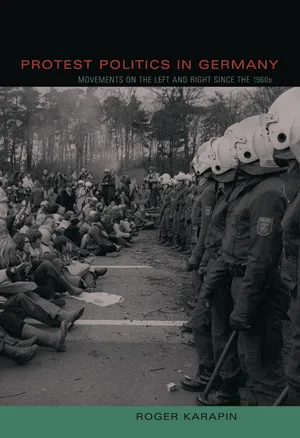
Protest Politics in Germany
Roger Karapin Protest Politics in Germany: Movements on the Left and Right since the 1960s Penn State Press 336 pages, 6 x 9 inches ISBN 978 0271029863
Available here →July 15, 2009
20090715-karapin-roger-protest-politics-germany-movements-left-right-2
The wide angle
The rest of this thread

Roger Karapin
Roger Karapin is Professor of Political Science at Hunter College and the Graduate Center, City University of New York. He has published many articles and book chapters on immigration politics, far-right parties, and anti-immigrant violence. His book, Protest Politics in Germany: Movements on the Left and Right since the 1960s won the 2008 Charles Tilly Award for the Best Book Published in Social Movements and Collective Behavior, presented by the American Sociological Association. His current research examines the effects of environmental policies on nature.
Pull this thread
German left and right protest movements grew by the same dynamics, bold actions, elite alliances and mistakes by police.
Know something the rest of us don't?
Most threads on Rorotoko begin with our invitation. Any thread can begin with a proposal: you write it with the same prompts every thread answers, and we review it.
Propose a thread →