
Roger Karapin
Protest Politics in Germany
When a large, influential protest movement occurs, I have found that it is the result of a remarkable confluence of factors, including mutually reinforcing actions by different actors.
In the southwestern German forest near Wyhl, protesters nonviolently occupied the site of a proposed nuclear power plant for fourteen months beginning in 1975. They held police at bay, built structures, improvised a community college on the site to educate sympathizers about ecology, and forced the conservative state government to halt construction and ultimately to abandon the plant.
How could the protesters accomplish this? They benefited from unusually favorable interactions. Their innovative and daring protests (e.g., tearing down the fence, occupying the site) were met at crucial times with authorities' responses that were either seen as too harsh (e.g., police dragging protesters through puddles of freezing water, officials claiming that local, churchgoing protesters were actually outside extremists) or too passive (e.g., police fraternization, failure to evict).
Those mistakes by authorities opened up opportunities for the site occupation to continue and thus for protesters to win allies from the Social Democrats (the opposition party in the state parliament), and concessions from the state government, which encouraged further protests. Protests grew in tandem with divisions among elites, in a mutually reinforcing process, until the authorities gave in.
To take an example on the right, skinheads and other right-wing youth rioted against foreign residents in the eastern German town of Hoyerswerda for a week in September 1991. A hundred attackers, supported by up to five hundred spectators, attacked and besieged the foreigners’ apartment building until officials removed the foreigners from the town. The influence of this widely televised riot went far beyond Hoyerswerda, as it touched off a wave of violence against foreigners across Germany and led to a major national debate on whether to limit the right to asylum. A similar riot in Rostock the next year had very similar effects on anti-foreigner violence and led to a constitutional restriction on the asylum right.
Again, the key to the Hoyerswerda protesters’ success was a series of interactions that benefited them by ratcheting up the conflict and giving them freedom to act with impunity. Hoyerswerda officials’ first mistake was to house foreigners in concentrated groups in a high-density neighborhood, which led to cultural frictions between them and the German residents. When neo-Nazis and right-wing youth responded with vigilante activities and isolated attacks against foreigners, the police looked the other way, and when the police arrested Vietnamese traders, the skinheads responded by launching their attack on the foreigners' housing. This, in turn, was met by cheering support from adult neighbors and days of passivity and understaffing by police. (The police were under the authority of a Christian-Democratic state interior minister; he served as an ally for the right-wing protesters, and later became a member of the far-right Republikaner party.)As on the left, this large and influential protest on the right developed because the actions of protesters, their political allies, and authorities reinforced each other. Hoyerswerda, by the way, had an unemployment rate that was below average for eastern Germany, a tiny and declining foreign population, and virtually no competition for jobs or housing between Germans and foreigners. Thus the kinds of socioeconomic explanations usually advanced to explain right-wing protest do not apply. The background conditions in Hoyerswerda were also very similar to those in another eastern town, Riesa, where a large skinhead group was repeatedly foiled in its efforts to mount significant protests against asylum seekers – because the political interactions in that case did not favor the growth of large protests.
I think the book shows that the relationships that political actors form with other actors can make a difference for the course of movement politics. There should be more attention on how those relationships initially develop, how they may objectively function in ways that may differ from subjective perceptions or public claims about those relationships, and the extent to which they can change or else tend to remain fixed once they settle into a certain pattern.
Another implication of the book is that local and state politics, in relatively decentralized systems like Germany or the U.S., can be more important than they are often thought to be. Important innovations in protest methods, new political relationships, and policy solutions to public problems often begin at the local or regional level and trickle upward.
For example, opposition to the demolition of entire neighborhoods in Germany led to more sensible and humane approaches to urban planning, in which apartments and whole neighborhoods were renewed for the existing residents. Opposition to nuclear power plants helped give birth to the green parties (plural because they were local and regional before there was a national party), with profound effects on the German party system. Local alliances in Kreuzberg foreshadowed the sometimes strained alliances between the Social Democrats and Greens at higher levels in later years.
Finally, the patterns of protest politics show that German politics is rooted in the past, in ways that make protest ambivalent for democracy. A politics of exclusion and violence has often been reproduced, as seen in the case studies of Brokdorf, Kreuzberg, Hoyerswerda, and Rostock. But this is not inevitable, as seen in the contrasting cases with which each of them is paired in the book. The Wyhl site occupation, and to a lesser extent the broadly supported squatter movements in Kreuzberg and Hanover-Linden, also show that a politics of creative nonviolent disruption has been gaining ground in Germany.
Editor: Erind Pajo
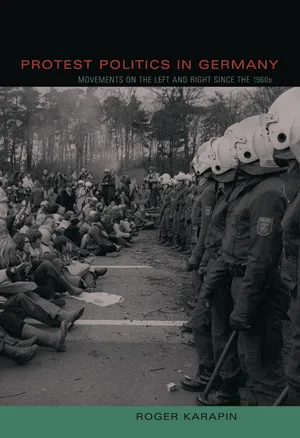
Protest Politics in Germany
Roger Karapin Protest Politics in Germany: Movements on the Left and Right since the 1960s Penn State Press 336 pages, 6 x 9 inches ISBN 978 0271029863
Available here →July 15, 2009
20090715-karapin-roger-protest-politics-germany-movements-left-right-3
A close-up
The rest of this thread

Roger Karapin
Roger Karapin is Professor of Political Science at Hunter College and the Graduate Center, City University of New York. He has published many articles and book chapters on immigration politics, far-right parties, and anti-immigrant violence. His book, Protest Politics in Germany: Movements on the Left and Right since the 1960s won the 2008 Charles Tilly Award for the Best Book Published in Social Movements and Collective Behavior, presented by the American Sociological Association. His current research examines the effects of environmental policies on nature.
Pull this thread
German left and right protest movements grew by the same dynamics, bold actions, elite alliances and mistakes by police.
Know something the rest of us don't?
Most threads on Rorotoko begin with our invitation. Any thread can begin with a proposal: you write it with the same prompts every thread answers, and we review it.
Propose a thread →