
Paul Fleming
Exemplarity and Mediocrity
Were a browsing reader to open my book at random, he or she could do worse than opening up to the third chapter, which deals with the average artist. Here I examine Goethe and Schiller’s notes and charts for an unrealized project on the “uses and damages” of dilettantism for art. It should be underscored that as a figure of mediocrity, the dilettante is not a complete hack. On the contrary, the dilettante has skills, shows diligence, and clearly is passionate about art, but ultimately lacks the natural gift, the je ne sais quoi that separates the genius (a rare figure) from the rest.
The stakes of Goethe and Schiller’s reflections, I argue, amount to this: they view the rise of dilettantism (which is concomitant with the bourgeois subject and the art market) not only as a new threat to art but also as a previously unheard-of possibility: the genuine aesthetic education of society. The more people try their hand at producing artworks, the greater the chance for developing a discerning public that could head-off the emergent divide between high and popular culture. Dilettantism, which threatens art by diluting it, is also the hope for saving it.
The possibility of such an aesthetically enlightened public comes, however, at the price of a new anxiety. In the face of the rapid proliferation of dilettantism, Goethe and Schiller, I argue, develop what amounts to an inverse form of Harold Bloom’s famous notion of the “anxiety of influence.”
Whereas Bloom theorizes the artist’s fear of being unduly influenced by previous great ones, Goethe and Schiller re-direct the artist’s anxiety—they worry about the influence of great art on prolific dilettantes, who (numerically) dominate the contemporary scene and then produce average but acceptable works in the mode of the maestro. The result is not only a dissolution of one’s perceived greatness; much more emphatically, if the average “artist” can produce art that seems to be of the same ilk as genius, then perhaps the fundamental divide between genius and average is more porous than one would like to think. This, I believe, is what Goethe and Schiller fear the most and the true anxiety of the dilettante-project: a quaking of the foundation of the aesthetics of originality, in which there could be something like a “genius” mode of imitation and derivation.
Goethe and Schiller’s answer to this threat is what I call an Art School for Non-Artists: a military-like academy that subjects the ambitious but (from their perspective) ultimately non-brilliant dilettantes to the most rigorous, rule-bound training in the arts, progressing with an exacting measure, step-by-step, to the ultimate goal: the dilettante realizing that the goal—being an artist—will never be expected. It is an art school in which failure is success or, rather, success lies in recognizing one’s failure.
Dilettantes, according to Goethe and Schiller, must learn that, regardless of what they produce, it will never be true art (the work of genius). The delicate balance of this special art school is to disabuse the amateur of all artistic aspirations while not crushing all interest in art. The school of the dilettantes is premised on the conviction that the lifelong amateur can best serve art by knowing its intricacies and techniques and then using this knowledge not to produce but to judge art works. This is the story of Wilhelm Meister’s Apprentice Years .One way to think about the book’s significance would be to consider it as an engagement with the inherent tension in the terms “average,” “common,” and “ordinary”—a tension that exceeds questions of art and goes straight to the heart of democracy. On the one hand, these terms express an optimum and an ideal, on the other, a pejorative sense of middling and mediocre quality.
One sees this tension within the notion of the “common man.” As a station in life and as a political voice, the common man is repeatedly celebrated, often as a locus of “truth,” of how things are “on main street.” But even here one does not want to fulfill this position in an average way; one wants to be an excellent, outstanding embodiment of the average man, its most perfect specimen. Alexis de Tocqueville already diagnosed this distinct psychosis of democracy, particularly in America: modern, democratic man suffers from two conflicting pathologies – the cult of equality (“I’m an average guy”) and the cult of individualism (“I’m different from everyone else”).
My book’s discussion of the literary permutations and strategies for addressing such a dilemma may help to consider this phenomenon on a larger, more pervasive scale.
Editor: Erind Pajo
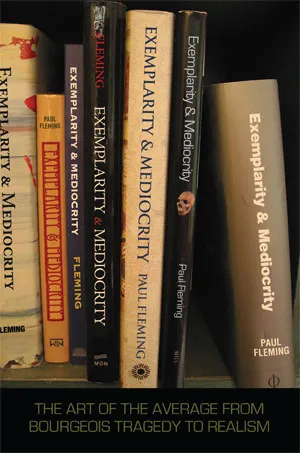
Exemplarity and Mediocrity
Paul Fleming Exemplarity and Mediocrity: The Art of the Average from Bourgeois Tragedy to Realism Stanford University Press 240 pages, 9 x 6 inches ISBN 978 0804758901
Available here →July 24, 2009
20090724-fleming-paul-exemplarity-mediocrity-art-average-bourgeois-tragedy-3
A close-up
The rest of this thread

Elke Siegel
Paul Fleming
An Associate Professor of German at New York University, Paul Fleming received his Ph.D. from Johns Hopkins in 2001. His first book, The Pleasures of Abandonment: Jean Paul and the Life of Humor (2006), addresses the relation between modes of the comic and radical finitude. He was the guest co-editor of the art-intellectual journal Cabinet on “the average” (vol. 15) and has translated Peter Szondi’s An Essay on the Tragic (2002) as well as Hans Blumenberg’s Care Crosses the River (forthcoming). The recipient of an Alexander von Humboldt fellowship, he is currently working on two projects: a shorter examination of the theoretical status of anecdotes within philosophy and a larger project on the theory and practice of “consolation.”
Pull this thread
What Goethe and Schiller most feared in dilettantism was porousness, the collapse of the divide between genius and average.
Know something the rest of us don't?
Most threads on Rorotoko begin with our invitation. Any thread can begin with a proposal: you write it with the same prompts every thread answers, and we review it.
Propose a thread →