
Lynne A. Isbell
The Fruit, the Tree, and the Serpent
I’m intrigued about the implications of the Snake Detection theory for human behavior, and, in the epilogue, I write most directly about humans.
Have you ever wondered about our ability to point for the purpose of sharing attention? My guess is probably not. But this truly is a special ability. A boy pointing up in the sky and saying, “Look! It’s a bird! It’s a plane! It’s Superman!” directs others to an object for the purpose of sharing attention. “Declarative pointing,” as this is called, is apparently unique to our species.
But why us and not any other species? What in our ancestors’ environment prompted the evolution of declarative pointing only in us?
Pointing draws our eyes closer to the target. If we want someone else to see a venomous snake barely visible in the grass, for instance, we might point to it to make it easier to find—and avoid. It turns out that we are more accurate at pointing down than up and quicker at responding when someone else points down rather than up. We also automatically look in the direction of the pointing finger—unless we purposely refuse to do so. In an environment with cryptic snakes and without the luxury of snake gaiters, these responses would seem quite helpful for reducing the frequency of deadly snakebites.
From the time our ancestors began to walk upright, the threat from snakes has come largely from the ground. But accompanying this new posture were eyes that were farther away from the ground and perhaps less effective at detecting well-camouflaged snakes. Those who happened to detect such snakes and point to share attention to them would have helped save others’ lives; those who responded most quickly and automatically would have been helped even more.
I link declarative pointing with social relationships. Think about this: we don’t point when we’re alone. Interestingly, declarative pointing is also closely linked with language, another skill done in a social context. For instance, the extent of infants’ involvement in declarative pointing (both their own and their mothers’) predicts the extent of vocabulary development when they become toddlers. People with autism don’t point declaratively nor do they have well developed language skills.
Gestures in general are often argued to have been a precursor to language. Is it possible that declarative pointing as a specific gesture helped facilitate the evolution of language? If so, then snakes could have led the way.
If I were to be granted one wish arising from The Fruit, the Tree, and the Serpent, it would be for readers to begin to see life a little differently. Some might understand deep time and evolution better. Others might appreciate more what our wonderful brains can do. Some might realize that they have greater control over themselves than they thought. Some might learn just how close is our biological connection with other mammals. Some might replenish their awe for life and the world that supports it all. Some might even begin to like snakes more. Some might be inspired to test the predictions presented in the book. Some might combine their talents to form interdisciplinary collaborations to conduct the tests.
I would love to see the Snake Detection theory more thoroughly tested than I have been able to do. That is the only way to determine if it will have lasting scientific merit. Right now, the Snake Detection theory is just at the stage that the theory of evolution by natural selection was at the time Charles Darwin published On the Origin of Species.
We have continued to test Darwin’s theory, and each test seems to make it stronger. I don’t know if the Snake Detection theory will have similar success. I would like it to, of course. But even if it doesn’t, that’s okay. In the process of finding out, we will gain greater understanding of who we’ve been, who we are, and our place in the world, both as the world has changed over the millions of years that it’s been our home and as it changes so rapidly now.
Editor: Erind Pajo
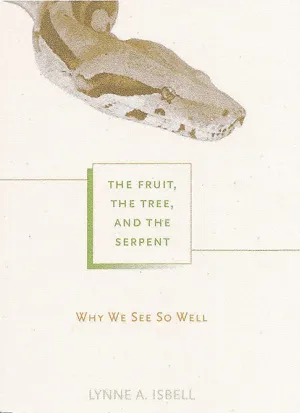
The Fruit, the Tree, and the Serpent
Lynne A. Isbell The Fruit, the Tree, and the Serpent: Why We See So Well Harvard University Press 224 pages, 9 x 6 inches ISBN 978 0674033016
Available here →August 7, 2009
20090807-isbell-lynne-fruit-tree-serpent-why-we-see-well-snake-detection-3
A close-up
The rest of this thread
Anup and Manoj Shah
Lynne A. Isbell
Lynne Isbell is a professor of anthropology and animal behavior at the University of California, Davis. Since 1980 she has focused her field research in East Africa, where she has conducted long-term studies on the behavior and ecology of red colobus monkeys in Uganda, and vervets and patas monkeys in Kenya. She has authored over 60 papers in numerous edited volumes and journals, including the Journal of Human Evolution, International Journal of Primatology, Behavioral Ecology and Sociobiology, American Journal of Physical Anthropology, and Animal Behaviour. She has had several close encounters with venomous snakes.
Pull this thread
Primates got their vision as prey, because constricting snakes were their first predators and selected for forward-facing eyes.
Know something the rest of us don't?
Most threads on Rorotoko begin with our invitation. Any thread can begin with a proposal: you write it with the same prompts every thread answers, and we review it.
Propose a thread →