
Alex Vernon
On Tarzan
One potential audience for On Tarzan is the American Studies classroom. Undergraduate scholars might enjoy the early discussion of the “juvenile” nature of the Tarzan narratives, the post-Darwin idea of adolescence, and the massive turn-of-the-century influx of immigrants that also informed its reception. Like fellow orphan-hero Harry Potter, Tarzan bears a forehead scar from a nearly fatal childhood battle that throbs when danger nears.
As I write in the first chapter, I hope that “scholars already well acquainted with Tarzan’s place in cultural history” will find plenty of new, “provocative perspectives.”
Writing the book was a learning process, and not just in terms of the universe of narratives and artifacts I call Tarzania. Books such as Rudi Bleys’ The Geography of Perversion: Male-to-Male Sexual Behavior Outside the West and the Ethnographic Imagination, 1750-1918 and Reinhold Wagnleitner’s Coca-Colonization and the Cold War: The Cultural Mission of the United States in Austria after the Second World War proved delightful and invaluable finds.
The late chapter on the incestuous subtext of the many Tarzan narratives is hardly a thoroughgoing Freudian analysis—a task for which I am eminently unqualified. It instead takes advantage of the coeval work of Ed Burroughs, Sigmund Freud, and Otto Rank, and employs this historical conjunction toward organizing information and ideas into what aims to be a provocative story behind the stories.
The chapter also, I fear, misses an opportunity to propose a clear hypothesis concerning the coinciding of this incest discourse with the swan song of Western colonialism, the rise in the United States of the New Negro, and the invention of heterosexuality. Namely, that as the old signals of savagery and the uncivilized—skin color and sexual “perversion”—were rapidly losing their power, incest became the imagined litmus.
I am not, and never was, a Tarzan aficionado. In childhood I occasionally watched Tarzan movies (or parts of them) on television, and I think I may have caught a few episodes of the Filmation animated series from the 1970s.
But, up until I decided to include the original novel in my course on American Literature and the Environment, I had never read any of the books, or any of the comics, or made any effort to see the films.
In the process of preparing for class, and through leading class discussion, I began to realize how incredibly the book transports us to early twentieth century America. As I began to muse about Tarzan’s persistence over the course of the century, I discovered to great surprise that no single book-length study of Tarzan existed. I wondered if perhaps I might be able to write that book.
So, I was pleased to read the following in one peer reviewer’s commentary on the manuscript:Tarzan, the book argues convincingly, is sometimes Jane, and sometimes Jane is Tarzan; what looks like bestiality is often racism and homophobia in disguised. Part of the book’s appeal is that it makes clear that without understanding the galaxy of versions of Tarzan, of incarnations in narrative and non-narrative form, one cannot appreciate the multifarious uses to which Tarzan has been put.
Tarzan the racist is here, but so are Tarzan the gay icon, Jane the masculine role model, and Kala the animal that radically calls the boundary between humans and animals into question. Even the imperialism that Tarzan (of British nobility born, to US liberal individualist sentiments inclined, and “Lord” of African territory made) has been argued to represent and to extend is reframed in On Tarzan in the context of the international success of the character¦ The phenomenon of Tarzan, the book argues, which seems so solid, simple, and reassuringly unified, derives its power instead from its paradoxical qualities—its ability to serve as a vector for different, even competing, cultural and political desires.
Not to mention this recent review in the Mooresville Tribune:
There's an urge to say, leave my icon alone. For the bold speculator, the book is fascinating.
Editor: Erind Pajo

On Tarzan
Alex Vernon On Tarzan University of Georgia Press 256 pages, 9 x 6 inches ISBN 978 0820332055
Available here →August 10, 2009
20090810-vernon-alex-on-tarzan-2
The wide angle
The rest of this thread
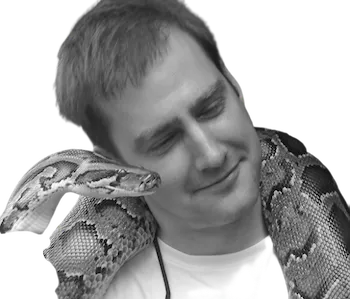
Alex Vernon
Alex Vernon attended the U.S. Military Academy and the University of North Carolina-Chapel Hill. The Eyes of Orion: Five Tank Lieutenants in the Persian Gulf War, won an Army Historical Foundation Distinguished Book Award; Military History magazine dubbed it “the single best book” on the war. His other memoir, most succinctly bred, was called “beautiful and smart and original” by novelist Tim O’Brien. Vernon’s primary work of scholarship on American war literature, Soldiers Once and Still, received a “highly recommended” endorsement from the American Library Association. He is currently an Associate Professor of English at Hendrix College in Conway, Arkansas.
Pull this thread
Tarzan's hold is a function of paradox, since the figure's power comes from serving competing desires at once.
Know something the rest of us don't?
Most threads on Rorotoko begin with our invitation. Any thread can begin with a proposal: you write it with the same prompts every thread answers, and we review it.
Propose a thread →