
Torben Grodal
Embodied Visions
Embodied Visions is a pathbreaking explanation of how films are crafted to activate innate features of our brains and bodies. The book is based on cutting edge neuropsychology and evolutionary psychology.
In the first part of Embodied Visions I show how the evolutionary history of humans and their mammal ancestors influences our preferences for certain types of narratives and themes, and how filmmakers create fascinating stories by appealing to these innate dispositions. I show how, for survival reasons, films for children focus on attachment to parents and on honing awareness of dangers. I also describe the evolutionary reasons for the preference for love stories, and explain why men are more interested in pornography than women.
Embodied Visions further describes how preferences for violence and hide-and-seek themes reflect our prehistoric survival needs. It is brain mechanisms that make supernatural stories like fairy tales and horror stories highly interesting; I describe these in the book, and also discuss why we are even interested in sad films. Sad films provide vital information of hazards and they also help create strong social bonds, for instance related to male bonding in war films.
The second part Embodied Visions is about how the architecture of the human brain explains central aesthetic features of films. The point of departure is to describe how we process films by means of what I have called the PECMA flow—short for “Perception, Emotion, Cognition and Motor Action.” I also discuss the brain mechanisms by which we simulate characters, for instance by means of so-called mirror neurons, that induce us to simulate emotions and actions of other people.
The flow model explains how sight and sound, say the sight of a wolf approaching a character, trigger emotions, which in turn trigger cognitions about what to do, which are then implemented in actions—running, hiding or fighting. Viewers continuously simulate the flow in empathy with characters. The book shows how stories are crafted to provide fascinating PECMA flows, as well as how art films violate the flow processes to create sophisticated aesthetic effects. Finally I describe the mechanisms that provide viewers with a sense of realism, as well as the ones filmmakers use to create the opposite effect—not of realistic worlds, but of subjective experiences of inner life.
The book also discusses the role of culture. Our brains have a flexibility that allows for cultural variation, and cultural development enhances the means to activate our innate dispositions.
Editor: Erind Pajo
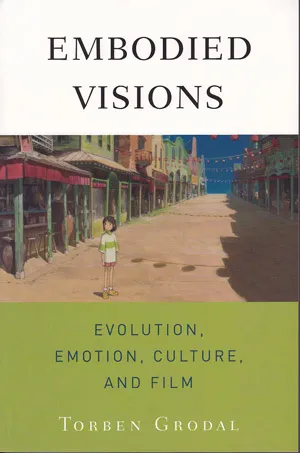
Embodied Visions
Torben Grodal Embodied Visions: Evolution, Emotions, Culture, and Film Oxford University Press 336 pages, 9 x 6 inches ISBN 978 0195371314 ISBN 978 0195371321
Available here →August 21, 2009
20090821-grodal-torben-embodied-visions-evolution-emotions-culture-film-1-1
In a nutshell
The rest of this thread

Pavel Bunin
Torben Grodal
Torben Grodal is professor in film studies at the University of Copenhagen. He started his academic career teaching comparative literature and writing books on structural text analysis and literary history. He shifted to film studies with a dissertation on the psychology of the film experience, published as Moving Pictures (Oxford University Press 1997). Grodal has published numerous articles on film genres, film and emotions, video games, film and evolutionary theory, and visual aesthetics, and an introduction to film studies, Filmoplevelse (in Danish). Embodied Visions is his latest book.
Pull this thread
pulls againstpulls alongside
What we want from film, love, violence, hide-and-seek, the supernatural, comes from innate mammalian and hunter-gatherer dispositions.
Against RL · People diagnosed with psychopathy are not meaningfully more violent than other offenders, and the diagnosis should leave legal use. On: Mental life reduces to states of the brain
Against JA · The Depression documentary book deconstructs witness, confronting readers with scattered voices rather than an authoritative picture. On: Formal radicalism in art carries a determinate political valence
Against MD · Confidence about animal consciousness outruns the evidence, and skepticism here helps animals rather than harming them. On: Emotion and passion are constitutive of sound judgment rather than distortions of it
Against JK · Natural science cannot settle judicial, legislative or personal questions, because those rest on ethical premises evidence cannot supply. On: Mental life reduces to states of the brain
Alongside AR · Nihilism is true, because science cannot justify the morality nearly everyone accepts, and it is harmless. On: Mental life reduces to states of the brain
Alongside KP · What social media did to politics cannot be understood without assembly, the form where arrangement itself is the utterance. On: Formal radicalism in art carries a determinate political valence
Alongside KR · Buying meat, eggs and dairy from small pastured farms is animal-centered even though the animals are killed. On: Emotion and passion are constitutive of sound judgment rather than distortions of it
Alongside SK · Modernism is a cognitive event, not a cultural one, which is why modern art has to be taught. On: Mental life reduces to states of the brain
Know something the rest of us don't?
Most threads on Rorotoko begin with our invitation. Any thread can begin with a proposal: you write it with the same prompts every thread answers, and we review it.
Propose a thread →