
Mabel Berezin
Illiberal Politics in Neoliberal Times
Illiberal Politics is a serious book on a serious topic. But it is also a lively book to read.
The French story, which occupies the 140-page middle section of the book, is replete with cartoons, newspaper images and photographs. And unlike many books on the European right, this book emphasizes context instead of the pronouncements of party leaders.
In the chapter on the National Front breakthrough in the 1998 regional elections, I also spend many pages discussing the 1998 World Cup Victory. The chapter on the 2002 Presidential election where Le Pen came in second place in the first round begins with a discussion of the popular film Amelie and how it figured in the mindset of French intellectuals and politicians. The chapter on the French rejection of the European constitution in 2005 deftly illustrates how citizens and politicians from all sides of the political spectrum converged in their antipathy to Europe.
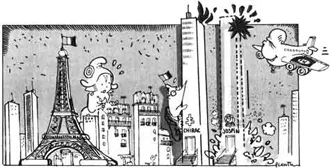
There are 20 illustrations in the book. I will simply include here one of my favorites.
This cartoon appeared on the front page of Le Monde in April 2002 after the first round of the Presidential election when the National Front’s leader Jean Marie Le Pen received enough votes to proceed to the second round—the run off in American terms.
The French viewed Le Pen’s victory as a political earthquake and national disgrace. The cartoon not only reflects how upset the French were over Le Pen, or at least the editors of Le Monde, but also suggests that they had lost a sense of proportion. The election occurred in April 2002—less than a year after the events of September 11 in New York City. (Incidentally, in the immediate aftermath of 9/11 the cover of the French newspaper Le Monde proclaimed in solidarity, “We are all Americans!”) The cartoon depicts Le Pen as a Nazi pilot of a small plane toppling the twin towers of Jospin, the Prime Minister, and Chirac, the President. These two men were supposed to be the contenders in the run-off election—not Le Pen. The cartoon also suggests that Le Pen has toppled the foundations of French democracy and the Republic.
Having spent most of my career, researching and writing on illiberal politics, I am convinced that most citizens live in the middle—not at the edges of either left or right. Political extremism of all stripes may generate violence and hatred—but it tends not to win elections. In that regard, I am extremely hopeful.
The lessons of this book extend beyond Europe. In an age that appears replete with threats from global terrorism to financial crisis, leaders and citizens ignore the link between democracy and security at their peril. A thick democracy—that is, a democracy that merges democratic sentiments and institutions—is difficult. It is difficult because democracy requires not only wealth as a material foundation but also a generalized public sense of largesse and empathy. But these are aristocratic as opposed to populist virtues—not because the mass public is intrinsically intolerant, unjust and unfair but because it is frequently not in the ordinary person’s interest to voluntarily share scarce cultural and material resources.
Modern nation-states made democracy possible by providing citizens with an expanded notion of security—domestic and international. Security is an emotional and practical concept—much like honor in non-modern societies. Security was institutionalized in the major institutions of membership of the modern nation-state: the army, the schools and social welfare, as well as in targeting enemies and identifying friends.
The challenges to contemporary democracy lie in the new relation between security and insecurity, in all its forms—material, cultural and emotional—that globalization creates. Secure states are democratic states no matter where they are geographically situated. Unless modern polities confront that issue, populism will continue to lurk in the interstices of even procedurally democratic nation-states.
Editor: Erind Pajo
Illiberal Politics in Neoliberal Times
Mabel Berezin Illiberal Politics in Neoliberal Times: Culture, Security and Populism in the New Europe Cambridge University Press 324 pages, 9 x 6 inches ISBN 978 0521547840
Available here →September 25, 2009
20090925-berezin-mabel-illiberal-politic-neoliberal-security-populism-europ-3
A close-up
The rest of this thread

Mabel Berezin
Mabel Berezin earned her Ph.D. at Harvard and is Associate Professor of Sociology at Cornell. Her book, Making the Fascist Self: The Political Culture of Inter-war Italy (Cornell 1997), received the J. David Greenstone Prize for Best Book of 1996-1997 in Politics and History from the American Political Science Association, and was named an “Outstanding Academic Book” by Choice. She is the editor, with Martin Schain, of Europe Without Borders: Re-mapping Territory, Citizenship and Identity in a Transnational Age (Johns Hopkins 2004). Berezin has been awarded fellowships from the Leverhulme Trust, the American Sociological Association Fund for Advancement of the Discipline, the German Marshall Fund of the United States, and the European University Institute.
Pull this thread
The European right's rise is an effect of neoliberal integration, not a residue of fascism.
Know something the rest of us don't?
Most threads on Rorotoko begin with our invitation. Any thread can begin with a proposal: you write it with the same prompts every thread answers, and we review it.
Propose a thread →