
Mabel Berezin
Illiberal Politics in Neoliberal Times
Right populist parties have been gaining electoral clout in Europe since the mid-1990s. Right wing parties are not new to European politics. What is new is that parties that analysts had viewed as extremist and fringe are attracting sufficient numbers of votes to become part of legally constituted governing coalitions.
This is a surprising development. Post-war Europe prided itself on having learned the lessons of fascism and Nazism. The last threat to European democracy, Communism, collapsed when the Berlin Wall fell in 1989. What happened that allowed right wing parties to once more lurk on the European political landscape?
Illiberal Politics in Neoliberal Times argues that the acceleration of European integration that began in 1992 with the Maastricht Treaty—the neo-liberal project of the New Europe—is fueling the emergence of a new European right. It shows why and how market fundamentalism creates social insecurities that right wing political parties exploit to their advantage.
The book weaves together three stories: first, the story of the success of the French National Front in the period between 1995 and 2005; second the story of European integration in France and in Europe writ large; and , the contrasting story of the right in other European countries. Illiberal Politics in Neoliberal Times makes the novel argument that security is a core component of democratic practice. Early theorists of democracy understood that feeling safe in one’s political space was a cornerstone of democratic empathy that fueled cosmopolitan, rather than narrowly nationalist, imaginings. Contemporary theories of democracy have elided the discussion of security that was crucial to earlier formulations.
Europe as a fully realized political union threatens the link between democracy and security, broadly conceived as social, political and cultural, that was the cornerstone of post-war peace and economic progress. By moving the center of political gravity from the polity to the person, from the state to the market, Europeanization has compromised the bonds of democratic empathy and provided an opportunity for right populists to articulate a discourse of fear and insecurity.
Editor: Erind Pajo
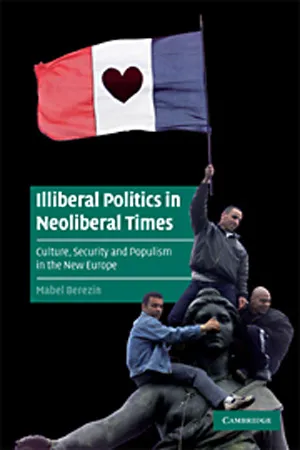
Illiberal Politics in Neoliberal Times
Mabel Berezin Illiberal Politics in Neoliberal Times: Culture, Security and Populism in the New Europe Cambridge University Press 324 pages, 9 x 6 inches ISBN 978 0521547840
Available here →September 25, 2009
20090925-berezin-mabel-illiberal-politic-neoliberal-security-populism-europ-1-1
In a nutshell
The rest of this thread

Mabel Berezin
Mabel Berezin earned her Ph.D. at Harvard and is Associate Professor of Sociology at Cornell. Her book, Making the Fascist Self: The Political Culture of Inter-war Italy (Cornell 1997), received the J. David Greenstone Prize for Best Book of 1996-1997 in Politics and History from the American Political Science Association, and was named an “Outstanding Academic Book” by Choice. She is the editor, with Martin Schain, of Europe Without Borders: Re-mapping Territory, Citizenship and Identity in a Transnational Age (Johns Hopkins 2004). Berezin has been awarded fellowships from the Leverhulme Trust, the American Sociological Association Fund for Advancement of the Discipline, the German Marshall Fund of the United States, and the European University Institute.
Pull this thread
The European right's rise since the mid-1990s is an effect of the neoliberal integration project begun at Maastricht.
Know something the rest of us don't?
Most threads on Rorotoko begin with our invitation. Any thread can begin with a proposal: you write it with the same prompts every thread answers, and we review it.
Propose a thread →