
Josh Lerner
Boulevard of Broken Dreams
Boulevard of Broken Dreams is the first extensive look at the ways governments have supported entrepreneurs and venture capitalists across decades and continents.
I examine the public strategies used to advance new ventures, point to the challenges of these endeavors, and reveal the common flaws undermining far too many programs—poor design, a lack of understanding for the entrepreneurial process, and problems in implementation.
The book explains why governments cannot dictate how venture markets evolve. Instead, governments must balance their positions as catalysts with an awareness of their limitations for stimulating the entrepreneurial sector.
Here are a handful of key points I develop in the book:Entrepreneurial activity does not exist in a vacuum. Therefore a critical first step for governments is to build environments where new ventures can thrive.
Governments should let the market provide direction when providing subsidies to stimulate entrepreneurial and venture activity.
Governments need to understand the need for interconnections with entrepreneurs and investors overseas. Instead of solely focusing on domestic activity, they should encourage global interconnections.
Governments should recognize the universal temptation for both individuals and organizations to take steps that benefit themselves. They should focus on minimizing that danger: a government’s mandate is to the benefit of the broader social good.
Editor: Erind Pajo
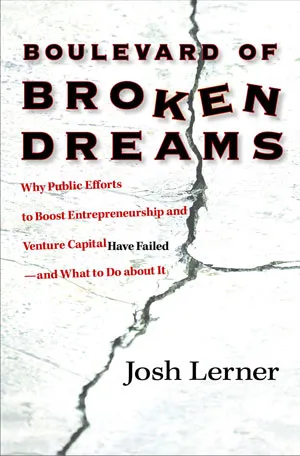
Boulevard of Broken Dreams
Josh Lerner Boulevard of Broken Dreams: Why Public Efforts to Boost Entrepreneurship and Venture Capital Have Failed—and What to Do About It Princeton University Press 248 pages, 6 x 9 inches ISBN 978 0691142197
Available here →October 12, 2009
20091012-lerner-josh-boulevard-broken-dreams-public-venture-capital-entrepr-1-1
In a nutshell
The rest of this thread

Josh Lerner
Josh Lerner is the Jacob H. Schiff Professor of Investment Banking at Harvard Business School, with a joint appointment in the Finance and Entrepreneurial Management Units. Besides Boulevard of Broken Dreams, his books include Innovation and Its Discontents, The Money of Invention, The Venture Capital Cycle, and the casebook Venture Capital and Private Equity (currently in fourth edition). Lerner teaches one of the largest elective courses at Harvard Business School, a doctoral course on entrepreneurship, and organizes an annual executive course on private equity in Boston and Beijing. He also leads an international team of scholars in a multi-year study of the future of alternative investments for the World Economic Forum. Lerner studied physics and history of technology at Yale, and did his Ph.D. in economics at Harvard.
Pull this thread
pulls againstpulls alongside
Governments cannot dictate how venture markets evolve, and most attempts have wasted billions.
Against BS · Socially responsible investing does not work and cannot, and the $30 trillion industry built on it is selling an illusion. On: Voluntary and market mechanisms can supply the public goods that states otherwise supply
Against DI · The subprime collapse was made by policy, deregulation since the early 1980s and capital markets wired directly to homeowners. On: Voluntary and market mechanisms can supply the public goods that states otherwise supply
Alongside JS · The prohibition on hosting kleptocrats' money fails for structural reasons, and the remedy is to recruit the profit motive. On: Voluntary and market mechanisms can supply the public goods that states otherwise supply
Alongside SM · Florida's tomato fields went from the country's worst labor conditions to among its best without a single new law. On: Voluntary and market mechanisms can supply the public goods that states otherwise supply
Alongside MK · The free-market growth that caused climate change is also what will let households and firms adapt to it. On: Voluntary and market mechanisms can supply the public goods that states otherwise supply
Alongside JD · Judged by its work for manufacturing, NAM's record is progressive as often as reactionary, and Reagan was its low point. On: Voluntary and market mechanisms can supply the public goods that states otherwise supply
Know something the rest of us don't?
Most threads on Rorotoko begin with our invitation. Any thread can begin with a proposal: you write it with the same prompts every thread answers, and we review it.
Propose a thread →