
Josh Lerner
Boulevard of Broken Dreams
It is hard to choose just one from the plentitude of examples—from all corners of the world—for how not to promote entrepreneurship.
But here is a striking case.
In 1970s and 1980s, the state legislature sought to boost economic development in the State of Kansas. Appropriating funds for this would have meant higher taxes and angry voters. So they simply mandated that the state’s pension for state employees loan money to local businesses and to Kansas real estate developers. And they somehow forgot to ask the public retirees if this was how they wanted their savings to be invested. By the mid-1980s, a full twenty percent of the multi-billion dollar pension had been earmarked for these home-grown investments.
Rather than undertaking the investments themselves, the pension recruited two local investment firms for the task. By the mid-1980s, frustrated at the slow investment pace, the State changed the instructions to the investment groups. Instead of backing seasoned and sound firms, they were now ordered to include new or expanding Kansas businesses that were unable to get credit elsewhere. The investment firms, who collected a fee on each transaction and had little supervision, began putting money to work much more quickly.
And they made some high-risk choices indeed. $14 million went to a manufacturer of microcomputer memories that never saw a profit, $8 million into a steel fabricating plant that would soon go belly-up, $6.5 million to a start-up that was going to develop a revolutionary hydrogen-based energy source, and so forth.
The most memorable investment was doubtless $65 million in loans to a local savings and loans institution which was seized by regulators as insolvent soon thereafter. Its loan portfolio, subsequent investigations revealed, included an uncompleted Hungarian film about a man-eating bear on chase of a rock-and-roll band—and a $40 million loan to the pension fund’s chairman!
In all, the fund ended up losing the state’s pensioners and taxpayers $265 million, or about seven percent of the pension’s assets at the time. After 13 years of litigation and $28 million in legal fees, the state recovered $41 million of those losses. The chairman ended up being ordered to perform 200 hours of community service.
Venture capitalists have suffered from very modest returns in recent years, and funds have found it difficult to achieve liquidity. So the public efforts to boost entrepreneurship and venture capital are coming out amid an ongoing public discussion about venture capital’s future.
I believe there are two sets of changes that could make a big difference.
The first is an evolutionary one, which is already underway. There has been simply too many dollars in the venture market, as can be seen, for instance, in the concentration of returns in the top 15 percent of funds. Too many groups have been able to raise capital from limited partners. Not only have too many groups had mediocre returns for long periods of time, they have undertaken a lot of “me too” investments, making it hard for everyone to succeed.
We are now seeing that many second- and third-tier groups are having much greater difficulty raising new capital. This is, of course, a frustrating turn of events from an individual perspective. But from the point of view of the industry as a whole, it cannot be seen but as a healthy development.
The second change relates to public policy. In too many areas, our system has made it hard to become an entrepreneur developing advanced technologies. From our current patent system overrun by sham litigation to the many barriers that public companies face, there are a whole variety of policies that create barriers to entrepreneurship. We need to revisit many of the “reforms” of recent decades—from the strengthening of patent rights to Sarbanes-Oxley. We need to really ask how they could be changed to minimize their harmful effects on entrepreneurs.
Editor: Erind Pajo
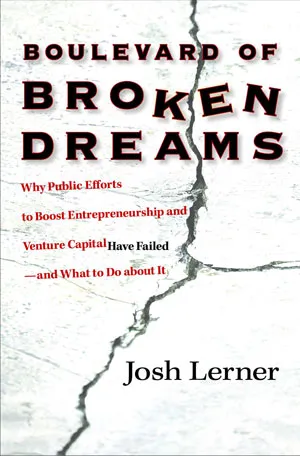
Boulevard of Broken Dreams
Josh Lerner Boulevard of Broken Dreams: Why Public Efforts to Boost Entrepreneurship and Venture Capital Have Failed—and What to Do About It Princeton University Press 248 pages, 6 x 9 inches ISBN 978 0691142197
Available here →October 12, 2009
20091012-lerner-josh-boulevard-broken-dreams-public-venture-capital-entrepr-3
A close-up
The rest of this thread

Josh Lerner
Josh Lerner is the Jacob H. Schiff Professor of Investment Banking at Harvard Business School, with a joint appointment in the Finance and Entrepreneurial Management Units. Besides Boulevard of Broken Dreams, his books include Innovation and Its Discontents, The Money of Invention, The Venture Capital Cycle, and the casebook Venture Capital and Private Equity (currently in fourth edition). Lerner teaches one of the largest elective courses at Harvard Business School, a doctoral course on entrepreneurship, and organizes an annual executive course on private equity in Boston and Beijing. He also leads an international team of scholars in a multi-year study of the future of alternative investments for the World Economic Forum. Lerner studied physics and history of technology at Yale, and did his Ph.D. in economics at Harvard.
Pull this thread
Governments cannot dictate how venture markets evolve, and most attempts have wasted billions.
Know something the rest of us don't?
Most threads on Rorotoko begin with our invitation. Any thread can begin with a proposal: you write it with the same prompts every thread answers, and we review it.
Propose a thread →