
Lynne A. Weikart
Follow the Money
America has had three revolutions: 1776, 1929 and Ronald Reagan’s New Federalism. The signs of the coming third American revolution were evident in 1975 when New York City experienced its worst fiscal crisis since the Great Depression. New York City presaged other municipal crises in the decade that followed.
New York had been a city of progressive thought and a provider of generous social services for its citizens beginning with the Great Depression of 1929 when Mayor Fiorello La Guardia, with the help of President Franklin Roosevelt, established extensive governmental services for city residents – public housing, new public schools, rent control, expansion of public health services, and an extensive park system.
But in the 1975 fiscal crisis, the financial elites in Wall Street sought to unravel the safety net of that earlier period. And, in large part, they have succeeded.
In many ways, municipal decision-making has been hidden; most New Yorkers did not know that the decisions made on Wall Street would affect their future. The curtain of privacy of hidden deal-making between politicians and financial elites raises only in times of fiscal crises when ordinary citizens begin to question the private deal making of Wall Street because those deals negatively affect the “real world,” the world of Main Street. During fiscal crises, we turn to government for help and leadership, leadership on every level - national, state and local.
This book explores the leadership of government on the local level. What goes on between the financial elites who control the nation’s purse strings and the political leaders elected by us, the citizens of New York City? What deals are made that affect the lives of ordinary New Yorkers? What compromises do New York City politicians make when dealing with the most powerful people in the financial world?
Editor: Erind Pajo
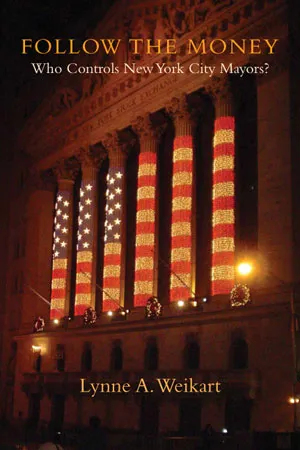
Follow the Money
Lynne A. Weikart Follow the Money: Who Controls New York City Mayors?SUNY Press 194 pages, 9 x 6 inches ISBN 978 1438425320
Available here →October 21, 2009
20091021-weikart-lynne-follow-money-who-controls-new-york-city-mayors-1
In a nutshell
The rest of this thread

Lynne A. Weikart
Lynne Weikart is the author of several articles and books in urban finance, particularly resource allocation as well as the budgeting process, including the budgeting and financial management textbook, Budget Tools: Financial Methods in the Public Sector, co-authored with colleagues. She received her Ph.D. from Columbia and taught at CUNY’s Baruch College School of Public Affairs. In 2001 she won the Luther Gulick Award for Outstanding Academic, New York Metropolitan Chapter of the American Society for Public Administration. Before her academic career Professor Weikart held several high-level government positions including Budget Director of the Division of Special Education in New York City’s public schools, and Executive Deputy Commissioner of NYS Division of Human Rights. For several years, she also served as Executive Director of City Project, a nonprofit, progressive, fiscal think tank focused on reforming New York City’s resource allocation patterns. Now in retirement, Professor Weikart lectures at the University of Virginia, and conducting research in urban finance and politics.
Pull this thread
In every New York City fiscal crisis since the Depression the financial elites won.
Know something the rest of us don't?
Most threads on Rorotoko begin with our invitation. Any thread can begin with a proposal: you write it with the same prompts every thread answers, and we review it.
Propose a thread →