
George Saliba
Islamic Science and the Making of the European Renaissance
I use the example of Copernicus, who literally picked up from Arabic texts almost all of the mathematical theorems he needed for the construction of his astronomy; these theorems were not found in the classical Greek texts.
When you mention Copernicus everybody gets a little jumpy, because we attribute to him the discovery of the earth moving around the sun. That Copernicus did not get from any Islamic astronomer that I know of. No Islamic astronomer I know of would believe in heliocentrism, or would allow a cosmology that is heliocentric. None of them, including Copernicus, had the ability to explain the physical structure of the universe—that explanation depended on an essential law that was yet to be discovered by Newton, a hundred years after Copernicus.
Yet, to explain how a planet moves around the sun, Copernicus needed the mathematical mechanisms that accommodate the movements of the planets. He needed a predictive model, to tell where the planet would be seen from the earth, at such and such a time. If you ask the question of where the planet will be seen from the earth, then you are already solving the problem for an earth-centered universe. And all of those answers were already found in the Islamic domain.
The question remains. Why did Copernicus do that? There are many people who answer that in so many different ways. But none of them is really cosmologically convincing. Because you would have to account for the force that holds the planets attached to the sun. Even Kepler, who comes after Copernicus, who should really be called the father of modern astronomy, even he was thinking that planets are attracting each other like magnets. Kepler used magnetism as a metaphor of that attraction because he still did not yet have Newton’s universal law of gravitation.
On the other hand, if you only think of it mathematically, it is irrelevant whether the center of the universe is at the sun or at the earth. This is how all the mathematics that was developed in the Islamic domain could be simply turned around and made heliocentric by Copernicus.
Why did this scientific activity not continue in Islam? I say a few things in the book about this concept of “decline.” People speak of rise and fall, of cyclical movement, for example about the rise and fall of the Ottoman Empire, or of the Roman Empire. I don’t give much credence to this view. Yes, the Roman Empire did end, but after one thousand and five hundred years. Decline is not about a cycle as such. It is when the historical conditions change that all things change—including the fortunes of empires.
If you look at the map of Europe in the year 1400, all of the trade routes crisscross right to the heart of what was called the Islamic domain. No European trader could conceive of making any money without paying part of it to a tax collector somewhere in an Islamic port or Islamic city. That map looks very different in the year 1550. All trade routes have shifted: they now go over the Atlantic. It was with the accidental discovery of the New World that the Islamic domain literally lost the primacy of trade.So the silly questions of what “went wrong” in Islam and why did the Muslims who had the science “miss it” are answered by another question, “Why and how did Europe actually produce science?”
That will be my next book. In the same way I addressed the mechanism of producing science in the early Islamic civilization, now I want to address the mechanism that translated that wealth, and the economic conditions, on the ground, into the production of science in Europe. How did the Europeans produce science that could not be imitated by the Islamic civilization—as well as by the civilizations of China and India, which are not Islamic?
Editor: Erind Pajo

Islamic Science and the Making of the European Renaissance
George Saliba Islamic Science and the Making of the European Renaissance MIT Press327 pages, 9 x 6 inches ISBN 978 0262195577
Available here →October 23, 2009
20091023-saliba-george-on-islamic-science-making-european-renaissance-3
A close-up
The rest of this thread
EP
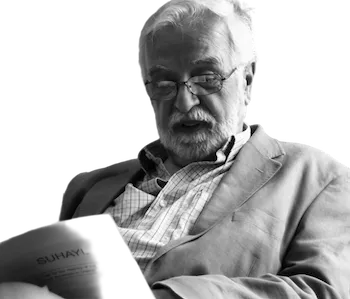
George Saliba
George Saliba is professor of Arabic and Islamic Science at Columbia University. He received his education from the American University of Beirut and the University of California, Berkeley, has been a Distinguished Senior Scholar at the Kluge Center of the Library of Congress, and visiting professor at several universities in the US, Europe and the Middle East. He has lectured at more than two hundred academic venues on four continents, and published close to two hundred articles as well as eight books—including, besides the one featured in the Rorotoko interview, A History of Arabic Astronomy: Planetary Theories During the Golden Age of Islam (NYU Press 1995).
Pull this thread
Islamic science grew from the needs of a new empire and competition among displaced bureaucratic families.
Know something the rest of us don't?
Most threads on Rorotoko begin with our invitation. Any thread can begin with a proposal: you write it with the same prompts every thread answers, and we review it.
Propose a thread →