
Bethany Moreton
To Serve God and Wal-Mart
Histories of the long, prosperous liberal consensus in the middle of the twentieth century looked back to the specific experience of the industrial North. The people and institutions of the New Deal order were urban, modern, radical, immigrant, internationalist. But rural Southerners made up influential segments of labor, management, and consumers for the economy that displaced Detroit after World War II. They drew on quite different experiences to build Fordism’s successor in the rising Sun Belt.
In Wal-Mart’s home territory, the company was largely staffed with people who left farms for service jobs without ever passing through factories.
They brought different ideologies with them—not the dynamo but the dime store, not the union but the Pentecostal church, not the heroic myths of industry but the parables of Christian service. When the American economy grew to its post-war dominance, then, it carried these traditions to an international stage. The economic vision we call neoliberalism, Thatcherism, Reaganomics, or free-market fundamentalism could also claim the title of Wal-Martism.
For the New Deal’s redistributive policies ironically pulled capital out of the industrial Northeast and down Route 66.
Then as now, the robust defenders of capitalism saw no contradiction in building private enterprise on public subsidy. So long as the state relinquished any right to oversight, the Sun Belt’s champions of free enterprise would deign to cash the checks—as would the burgeoning faith-based sector. With its infrastructure in part underwritten by the public, Christian free enterprise grew up through the new service industries of the South and West. Just as the shock of factory discipline had reverberated through the culture of an earlier century, the new experience of mass service employment demanded a new ethos of service to dignify it.
On the job, at church, and in many evangelical homes, this elevation of service work—reproductive labor—evolved into the Biblically-inflected management philosophy of “servant leadership.”
Caught up in a regional revival, the white working mothers who staffed the stores changed the nature of their work as surely as the Flint sit-down strikers had a generation earlier. But the labor victories at the early Wal-Mart addressed different priorities, and so didn’t register within the terms set by the old industrial narrative. To Serve God and Wal-Mart uncovers these hidden struggles, without whitewashing the fundamental moral violence of a Wal-Mart economy.

From the author’s collection
Editor: Erind Pajo
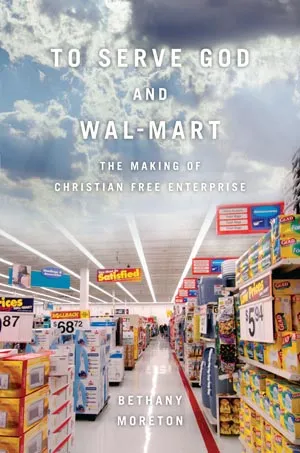
To Serve God and Wal-Mart
Bethany Moreton To Serve God and Wal-Mart: The Making of Christian Free Enterprise Harvard University Press 252 pages, 9 x 6 inches ISBN 978 0674033221
Available here →November 4, 2009
20091104-moreton-bethany-serve-god-wal-mart-christian-free-enterprise-2
The wide angle
The rest of this thread

Peter Frey
Bethany Moreton
A native of Mississippi, Bethany Moreton completed her Ph.D. in history at Yale in 2006. She spent a year as a Visiting Scholar at the American Academy of Arts and Sciences before taking up her current position as Assistant Professor of History and Women’s Studies at the University of Georgia. In addition to To Serve God and Wal-Mart, she has published articles on globalization, service labor, and conservative Christianity in the U.S. and Latin America. The Center for the Humanities at the University of Michigan named her the 2009 Emerging Scholar. She has assigned her share of the proceeds from To Serve God and Wal-Mart to the Economic Justice Coalition of Athens, Georgia and Interfaith Worker Justice of Chicago.
Pull this thread
The marriage of evangelical religion to free-market economics is a product of the service economy.
Know something the rest of us don't?
Most threads on Rorotoko begin with our invitation. Any thread can begin with a proposal: you write it with the same prompts every thread answers, and we review it.
Propose a thread →