
Greg Robinson
A Tragedy of Democracy
If I had to select at random a section to commend to a reader, I think I would choose the section of Chapter 5 that deals with the history of the martial law regime in Hawaii. I think this is my most original contribution, because it tells a story that most Americans are not aware of, yet has direct parallels with the present. After Pearl Harbor the U.S. Army commander pushed through a declaration of martial law in what was then the Territory of Hawaii, suspended the U.S. Constitution, dismissed the elected government, and declared himself military governor.
The Army meanwhile threw the judges out of the courts and created instead a set of military tribunals to judge all criminal cases, even those involving American civilians. Defendants had no due process or legal protections. Virtually all those accused were found guilty, and often given harsh or arbitrary sentences (for instance, they could reduce their felony sentences by agreeing to donate blood).
Eventually these military tribunals were challenged in court. The Army and the Justice Department, knowing that they had no possible chance to prove that there was any real military emergency or threat of imminent invasion from Tokyo, instead based their case for martial law on the threat of Japanese Americans. Eventually the case went all the way to the U.S. Supreme Court as Duncan v. Kahanamoku (1946). In a landmark ruling, the Supreme Court said clearly that military tribunals to judge civilians are unconstitutional, and the opinion of the Court contained some very strong language denouncing the Army’s action as tyrannical.
So the events in Hawaii not only present an interesting counterpoint to what happened to Japanese Americans on the mainland, but they also tell a kind of prehistory that we should be thinking about when we look today at Guantanamo and the military tribunals there. Yet the story of martial law and Duncan v. Kahanamoku is really absent, not just from popular discussion but also from law and American studies classes, the study of constitutional law, and legal briefs. It deserves to be looked at much more closely.I have learned to restrain myself from trying to anticipate too much what consequences or implications a book will have.
My first book, By Order of the President, came out only a few weeks after the attacks of September 11, 2001. Though I wrote the book long before the attacks took place, my message about the perils of overreacting in a climate of uncertainty and fear gained a special resonance and timeliness from them. As a result, the book was reviewed and featured in places where normally such a work would not appear. It has remained ever since the work that I am best known for. I do not know whether A Tragedy of Democracy will speak as much to the issues of the moment, or exactly what people will make of it.Most probably these two books will be compared, especially since both cover the removal of Japanese Americans. Still, they are very different works.
By Order of the President was largely an executive history, which brought Franklin Roosevelt and the White House into the well-trodden existing narrative of the camps, and it had little to say abut the Japanese Americans themselves. I made heavy use of the existing literature and available published documents, and was mortified when reviewers either praised or castigated me for my discussion of the larger history of the camps, as that part of things was mostly not original with me.
A Tragedy of Democracy is a more ambitious work, which attempts to synthesize a great deal of new information on the experience of Japanese Americans at the same time that it brings together histories of confinement in different countries—histories that have only been studied in isolation. What I hope people take away from it is a sense of how fragile our liberties are—not just those of US Americans, but of people in democratic societies throughout the continent—and how easy it is in time of emergency to suspend judgment and give excess power to military authorities with a plausible claim of national security.
The case of the Japanese Americans underlines most strongly the wise words attributed to Benjamin Franklin, “Those who would give up Essential Liberty to purchase a little Temporary Safety, deserve neither Liberty nor Safety.”
Editor: Erind Pajo
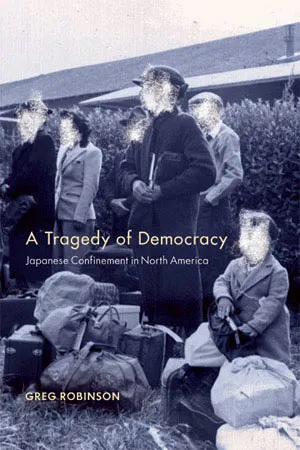
A Tragedy of Democracy
Greg Robinson A Tragedy of Democracy: Japanese Confinement in North America Columbia University Press 408 pages, 9 x 6 inches ISBN 978 0231129220
Available here →November 6, 2009
20091106-robinson-greg-tragedy-democracy-japanese-confinement-america-3
A close-up
The rest of this thread

Greg Robinson
Greg Robinson, a native New Yorker, is Associate Professor of History at l'Université du Québec À Montréal, a French-language institution in Montreal, Canada. A specialist in North American Ethnic Studies and U.S. Political History, he is also the author of the book By Order of the President: FDR and the Internment of Japanese Americans (Harvard University Press, 2001) and coeditor of the anthology Miné Okubo: Following Her Own Road (University of Washington Press, 2008). His historical column “The Great Unknown and the Unknown Great,” was a well-known feature of the Nichi Bei Times newspaper.
Pull this thread
Japanese confinement was a continental pattern, from British Columbia to Mexico and Hawaii, with momentum built before Pearl Harbor.
Know something the rest of us don't?
Most threads on Rorotoko begin with our invitation. Any thread can begin with a proposal: you write it with the same prompts every thread answers, and we review it.
Propose a thread →