
Greg Robinson
A Tragedy of Democracy
This book is the final product of a long train of circumstances and developments. It was more than ten years ago that I started doing research on the signing of Executive Order 9066, for what ultimately became my first book, By Order of the President: FDR and the Internment of Japanese Americans, published by Harvard in 2001.
At first, I was interested mostly in filling a hole in the existing historiography: books on the confinement of Japanese Americans ignored the role of President Franklin Roosevelt, while books on Roosevelt did not discuss Japanese Americans. In the process of research, I not only found much more new information than I expected—or that I could fit into one volume—but I realized just how much the wartime removal of Japanese Americans has influenced American society, literature, and law.
In fact, it has become one of those central events in American life, a central historical reference point in public debate and the subject of numerous fictional works, exhibits and commemorations by both Japanese Americans and others.
Yet I realized that most ordinary people did not know a great deal about what happened. Thus, once I finished the Roosevelt book I decided to write a short study that would give a clear and easy-to-follow version of the scholarly consensus in regard to Japanese American confinement.
The need seemed even more pressing after the September 11 attacks and the U.S. invasion of Iraq, which reopened old debates about immigration, race, and patriotism. I realized just how vital the issue of Japanese confinement and its proper understanding was when the conservative columnist Michelle Malkin published a popular work challenging the consensus narrative and defending the government’s wartime removal policy as a successful instance of racial profiling.
My interest in retelling the story, though, was increasingly overshadowed by an uneasy sense that the accepted version was inadequate—though not mistaken—and that more needed to be done to flesh it out. As I said, my inspiration came in part from own experience of immigrating to Canada and teaching in Montreal, which led me to study American History from a North American point of view. As I learned Canada’s history, I saw both parallels and differences with developments in the United States. Both of these were useful to study, as they tested widespread assumptions by Americans that our national history and culture are unique.
In the same way, as I read up further on the wartime treatment of Japanese Canadians, and discovered how deeply they had been victimized by their own removal policy, I was very surprised that no book had really examined the similarities and differences between the two. It dawned on me that a comparative North American study would be interesting.
Another revelation came when I visited Hawaii for the first time in 2006. I had always heard that Hawaii was a place of overall racial harmony and good relations, and that the Japanese Americans had been spared mass removal during World War II thanks to the enlightened policies of the military government in power during those years. During my trip, however, I heard some of the stories of martial law and of the military tribunals that had dispensed arbitrary justice.
I slowly realized that the apparent contradiction between tolerance and authoritarianism was in fact not so absolute: the military governor in Hawaii had indeed refused to round up masses of Japanese Americans, and had ultimately allowed Americans of Japanese ancestry to join the Army and prove their loyalty.
Yet, almost in the same breath, the Army proclaimed that the presence of so many Japanese Americans at large was a danger.
Indeed, as the years went by after Pearl Harbor, and the threat of an invasion by Tokyo became less and less plausible, Army commanders increasingly played the race card, justifying military rule over civilians on the basis that the menace of Japanese Americans made it necessary. There was an essential connection between the military invasions of constitutional rights of Japanese Americans both on the mainland and in Hawaii.
In the process, I realized that the book had to look at events in transnational fashion, to look beyond the mainland United States.
Ironically, even though I am recounting a seemingly familiar story, there is actually a rather more original research in this book than in By Order of the President. Part of this is that I had the good fortune to be around for the explosion of internet-searchable documents as a research tool over the past few years. I found all sorts of sources—newspaper articles, interview transcripts, legal briefs, census records, and finding aids. The information is also the result of several years of devoting considerable time to poring over sources from the period in different libraries and archives.
Editor: Erind Pajo
A Tragedy of Democracy
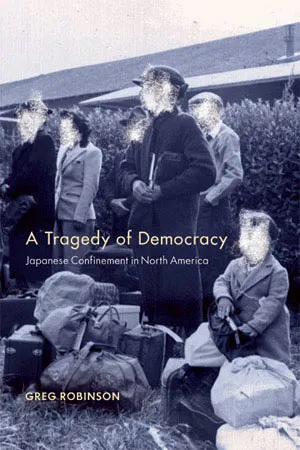
Greg Robinson A Tragedy of Democracy: Japanese Confinement in North America Columbia University Press 408 pages, 9 x 6 inches ISBN 978 0231129220
Available here →November 6, 2009
20091106-robinson-greg-tragedy-democracy-japanese-confinement-america-2
The wide angle
The rest of this thread

Greg Robinson
Greg Robinson, a native New Yorker, is Associate Professor of History at l'Université du Québec À Montréal, a French-language institution in Montreal, Canada. A specialist in North American Ethnic Studies and U.S. Political History, he is also the author of the book By Order of the President: FDR and the Internment of Japanese Americans (Harvard University Press, 2001) and coeditor of the anthology Miné Okubo: Following Her Own Road (University of Washington Press, 2008). His historical column “The Great Unknown and the Unknown Great,” was a well-known feature of the Nichi Bei Times newspaper.
Pull this thread
Japanese confinement was a continental pattern, from British Columbia to Mexico and Hawaii, with momentum built before Pearl Harbor.
Know something the rest of us don't?
Most threads on Rorotoko begin with our invitation. Any thread can begin with a proposal: you write it with the same prompts every thread answers, and we review it.
Propose a thread →