
Andre Wakefield
The Disordered Police State
Schloss Friedenstein, the seventeenth-century palace that Ernst the Pious of Gotha built, is a good place to do research: on one side, in the east wing, the old research library; on the other side, in the west wing, the secret archive of Ernst the Pious. It is an impressive physical space. Day by day, as I ate my lunch under Pious Ernst’s statue and walked up the steep hill from town with his palace looming over me, the presence of the place—its vaults, fortifications, chambers, and halls—had an impact. I started wondering about spaces and rooms, and about the treasury; not the abstracted treasury of administrative history, or the idealized treasury of the cameral sciences, but the specific room where the duke met in council with his officials. In the conclusion I describe a large tabular chart that I found in the Schloss Friedenstein.
This “table of duties” dictated every aspect of behavior for the duke’s officials; it was hanging in Pious Ernst’s fiscal chamber when a famous cameralist named Seckendorff worked there. Initially, the chart struck me as a perfect example of early modern social discipline, a case study in Foucauldian mechanisms of control and surveillance. By subdividing space and time to provide transparency and visibility, it was a cog in the machinery of control that characterized early modern Europe.I eventually decided that this was wrong. The table of duties was really an example of wishful thinking, because the people it aimed to discipline and control did not exist. Seckendorff’s imagined bureau had no meetings, no votes, and no timetables. He was pretty much by himself. The elaborate table of duties corresponded only to the fantasies of its author.I focus on this episode here because it serves as a microcosm of my larger argument. Historians have been conditioned to look for certain things in archives and libraries, so that research becomes a self-fulfilling prophecy. We find what we expect to find.
There is no simple way out of this trap, unless you believe in the myth of the objective historian.In the eighteenth century, German political economists repeatedly promised that they could harness science to improve the common good. These claims later reappeared as evidence for the connection between science and economic development during the Enlightenment. Some contemporary social scientists have even suggested that the cameralists present a “third way” for economic development, an alternative model to both Marxist and neo-liberal approaches. The sources that historians have used to link Enlightenment science with material progress are not transparent. Professors and state officials, desperate for employment and keen for promotions, created the fiction of well-ordered police states through their regulations, books and treatises.
They argued that science, properly cultivated, created prosperity for princes and their people. When these author-administrators tried to put their ideas into practice, however, the results were usually disastrous.History is only as good as its sources, and the cameral sciences, which pretended to speak publicly about the most secret affairs of state, were deeply dishonest. We cannot trust them, and we cannot trust narratives built on them. I hope that my book adds a note of skepticism to current debates about science and economic development. We don’t know as much as we think we know.If the history of state building and state finance is about progressive models of development, about the relentless march to us, then it makes little sense to study the petty principalities of early modern Germany, those Galapagos Islands of state building. But if we suspend our judgment about the inevitable destiny of the world’s political and economic dodos, replacing categories of hierarchy with difference, perhaps we can begin to understand what these forgotten states actually produced instead of how they failed. Release the past and you release the future.
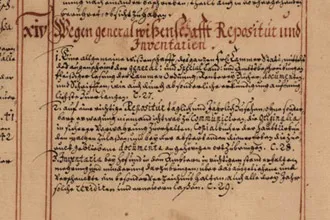
Fragment from the 1655 Fürstlichen Cammerordnung, a table of duties for state officials (Thüringisches Staatsarchiv Gotha). It appears in the book on page 135.
Editor: Erind Pajo
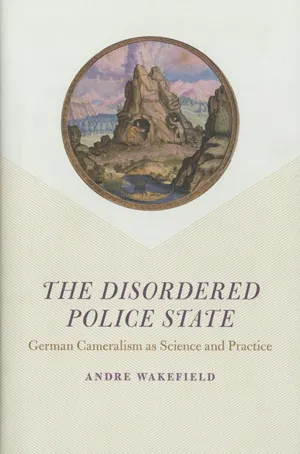
The Disordered Police State
Andre Wakefield The Disordered Police State: German Cameralism as Science and Practice University of Chicago Press240 pages, 9 x 6 inches ISBN 978 0226870205
Available here →November 13, 2009
20091113-wakefield-andre-on-the-disordered-police-state-german-cameralism-3
A close-up
The rest of this thread
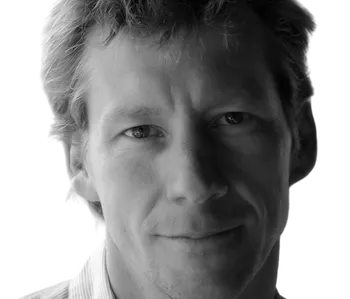
Andre Wakefield
Andre Wakefield is Associate Professor of History at Pitzer College in Claremont, California. He is the editor and translator, with Claudine Cohen, of G. W. Leibniz’s Protogaea (Chicago, 2008) and is currently working on a book about Leibniz’s misadventures in the mines of the Harz Mountains. He enjoys teaching and writing about the history of science, deep time, environmental history, political economy and world soccer. Wakefield earned his Ph.D. from the University of Chicago. He lives in Claremont with his wife, Rebecca Kornbluh, his sons, Zachary and Eli, and a large black dog named Bernie.
Pull this thread
The German cameral sciences were fiscal propaganda written by men hunting salaries and promotions.
Know something the rest of us don't?
Most threads on Rorotoko begin with our invitation. Any thread can begin with a proposal: you write it with the same prompts every thread answers, and we review it.
Propose a thread →