
Andre Wakefield
The Disordered Police State
I was trained in the history of science, a field much concerned with the relationship between discourse and practice. This influenced the course of my research, which was driven by one simple question: what did these scientific administrators actually do, and how did it relate to what they published?
It is common knowledge that some of the most prominent cameralists had careers as state officials. Historians, political scientists and sociologists have thus mostly assumed that the sciences of state reflected administrative practice. But hardly anybody has bothered to check on that. So I spent years traipsing through Germany and pawing through local archives.
What I discovered was surprising: the secret discourse of the treasury contradicted the public discourse of state administration. In other words, scientific administrators said vastly different things in secret than they did in public.
Many of their published writings were meant not to rationalize the state, but to make the prince and his government look good.
So who cares if a group of largely forgotten author-administrators misled the public once? I care because our larger narratives about science, economic development, and the Enlightenment rest on the foundation of stories like this one. It may be, for example, that a certain scientific culture, incubated in the European Enlightenment, helped spark the Industrial Revolution. But I don’t believe it, because the sources are suspect. Admittedly, it can be daunting to revisit the sources: there are a lot of them, and they can be very dull. Faced by walls of obscure history books at the library, or forced to listen to some interminable lecture about agricultural improvements in early modern Bavaria, it is tempting to leave all of this to the “experts,” those with the time, patience and knowledge to sift through the material.
This assumes however that history books, neutral and objective, simply regurgitate the distilled contents of the past. We should not conflate monotony with neutrality.
William James once joked that modern experimental psychology could only have arisen in Germany, a place whose inhabitants were incapable of being bored. You could say the same thing about the history of state administration: perhaps only Germans could have produced the intimidating, detailed, colossal administrative histories that helped make Prussia, with its well-disciplined soldiers and anal-retentive bureaucrats, into the ideal type of a modernizing state. More recent variations, like Foucault’s celebrated riff on the disciplined bodies of Prussian infantrymen, have only served to cement that reputation.
But it is time to rethink the evidence upon which these claims rest. It seems obvious now that a powerful mix of science, technology, discipline, and bureaucracy created our particular cocktail of modernity. In fact, it seems so obvious that we routinely project this narrative back onto the past, displacing it onto histories where it does not belong. This is how imagined pasts become justifications for the present. It is the vicious circle of anachronism.
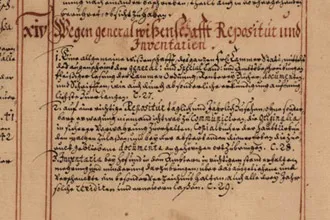
Fragment from the 1655 Fürstlichen Cammerordnung, a table of duties for state officials (Thüringisches Staatsarchiv Gotha). It appears in the book on page 135.
Editor: Erind Pajo
The Disordered Police State
Andre Wakefield The Disordered Police State: German Cameralism as Science and Practice University of Chicago Press 240 pages, 9 x 6 inches ISBN 978 0226870205
Available here →November 13, 2009
20091113-wakefield-andre-on-the-disordered-police-state-german-cameralism-2
The wide angle
The rest of this thread
Andre Wakefield
Andre Wakefield is Associate Professor of History at Pitzer College in Claremont, California. He is the editor and translator, with Claudine Cohen, of G. W. Leibniz’s Protogaea (Chicago, 2008) and is currently working on a book about Leibniz’s misadventures in the mines of the Harz Mountains. He enjoys teaching and writing about the history of science, deep time, environmental history, political economy and world soccer. Wakefield earned his Ph.D. from the University of Chicago. He lives in Claremont with his wife, Rebecca Kornbluh, his sons, Zachary and Eli, and a large black dog named Bernie.
Pull this thread
pulls againstpulls alongside
The German cameral sciences were fiscal propaganda written by men hunting salaries and promotions.
Against LR · Iraq's antiquities were pillaged for structural reasons, and most of the people involved acted in good faith. On: Moral evaluation of past actors belongs inside scholarly explanation of them
Against RE · The 1743 Memoirs of an Unfortunate Young Nobleman, reprinted as a novel, is substantially true. On: The reasons participants give for what they do are reliable evidence about why they do it
Against JS · The judgment of history is a fantasy, and history renders no verdict at all, only a record of contention. On: Moral evaluation of past actors belongs inside scholarly explanation of them
Against EC · Ordinary early Americans, not legislators, made the legal culture, because even the illiterate and enslaved knew the common law. On: The reasons participants give for what they do are reliable evidence about why they do it
Alongside KF · Indigenous North America is a 20,000-year record of invention whose architecture stands comparison with medieval Europe's. On: Moral evaluation of past actors belongs inside scholarly explanation of them
Alongside TW · Jazz history, told as a succession of God-like male heroes, enforces masculine and heterosexual norms. On: The reasons participants give for what they do are reliable evidence about why they do it
Alongside AS · A social worker's finding of neglect is as factual as a doctor's reading of a blood-pressure number. On: Moral evaluation of past actors belongs inside scholarly explanation of them
Alongside WG · Ordinary Soviet citizens made the Great Terror, writing denunciations and naming names out of belief and fear at once. On: The reasons participants give for what they do are reliable evidence about why they do it
Know something the rest of us don't?
Most threads on Rorotoko begin with our invitation. Any thread can begin with a proposal: you write it with the same prompts every thread answers, and we review it.
Propose a thread →