
Ann Campbell Keller
Science in Environmental Policymaking
I came to this subject with a longstanding interest in the role of scientists in US policymaking. Growing up as the daughter of a climate scientist, I gained early exposure to the dual roles that many climate scientists play. On the one hand, they are researchers striving to advance scientific knowledge. On the other, they find themselves bearing the responsibility of raising public awareness about a truly global problem that is beset with uncertainty.
In graduate school, I sifted through thirty years worth of research on the role of science in policymaking and found that scholars had come to a stalemate over the question of whether scientists’ role in policymaking mattered at all. To over-generalize, political scientists tend to downplay the role of scientists and the role of expertise in policy processes. Social scientists who work under the heading of science, technology, and society (STS), on the other hand, argue that science profoundly shapes modern politics, though perhaps not in obvious ways.
As if to emphasize the point that these somewhat calcified positions needed further wrangling, two early reviewers of the book both dismissed the question about scientists in policymaking as old and settled. Luckily for me, each came down on a different side of the putative “settlement”—one reviewer argued everyone knows scientists have no role, and the other contended that scientists’ influence is well established.
These views persist, in part, because studies that ask what role scientists play in policymaking tend to rely on case material drawn from a single setting and do not seriously evaluate the generalizability of their findings. In this longstanding debate, I take a close look at the role that setting plays in shaping scientists’ participation.
My research design has a longitudinal component that tracks changes over time—we see an evolution in the policy debates for both acid rain and climate change. In addition, the research allows for a cross-sectional comparison that highlights common features of the two cases and calls out their respective idiosyncrasies.
The approach is relatively novel and contributes to theories of policymaking by showing the extent to which scientists’ role in agenda setting has been overlooked. While prior studies place agenda setting in the hands of prominent elected officials like presidents and senators, the evidence here suggests that these actors rely heavily on scientists’ framings of policy issues in the environmental domain.
In addition, the book challenges political scientists to consider the specific role of scientists in legislative policymaking. It includes an in-depth analysis of the witnesses participating in congressional hearings on acid rain and climate change. The book also speaks to constructivist approaches to the study of science in society by showing that, although ideas about science and objectivity in policy settings are often contested, not every claim about science and objectivity becomes the subject of debate. In fact, claims about the content of scientific research or who should speak for science are often broadly accepted during environmental policy debates.
The book should appeal to political scientists, STS scholars, those with a general interest in sociopolitical theater, scientists who participate in environmental policy processes, and anyone interested in the legislative and political histories of acid rain and climate change.
Editor: Erind Pajo
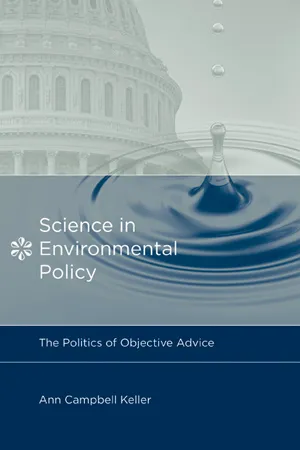
Science in Environmental Policymaking
Ann Campbell Keller Science in Environmental Policymaking: The Politics of Objective Advice MIT Press 304 pages, 9 x 6 inches ISBN 978 0262512961
Available here →November 16, 2009
20091116-keller-ann-on-science-environmental-policymaking-politics-advice-2
The wide angle
The rest of this thread

Peg Skorpinski
Ann Campbell Keller
Ann Keller is an assistant professor at the UC Berkeley School of Public Health. She holds a Ph.D. in political science from UC Berkeley and was a postdoctoral fellow with the Robert Wood Johnson Scholars in Health Policy Research Program. Keller is currently working on an NSF-funded study to analyze the organizational and analytic challenges of responding to global infectious disease outbreaks. Her research appears in the Journal of Public Administration Research and Theory, Public Administration Review, Frontiers in Ecology and the Environment, and The Nonproliferation Review.
Pull this thread
Scientists may advocate during agenda setting, where framing power sits, and are disciplined into objectivity as policy formalizes.
Know something the rest of us don't?
Most threads on Rorotoko begin with our invitation. Any thread can begin with a proposal: you write it with the same prompts every thread answers, and we review it.
Propose a thread →