
Ann Campbell Keller
Science in Environmental Policymaking
The book offers a systematic explanation of the changes in role-expectations that scientists who participate in environmental policymaking will face. It is rocky terrain that, for some scientists, is difficult to negotiate. To substantiate the argument, I rely on a mix of qualitative and quantitative analysis.
To get a flavor for this, one might look at the section in Chapter 3 where I present the different strategies scientists have employed in presenting their arguments during congressional hearings. Perhaps because political science, as a discipline, has tended to dismiss the role of scientists in policymaking, there has been almost no empirical work on scientists as a distinct type of witness in a congressional hearing.
The data here are fascinating. They make clear that scientists do have to wrestle with the idea that their participation is predicated on their objectivity. This issue arises repeatedly: members of Congress first invoke scientific objectivity and then try to lure scientists into making explicit policy recommendations. Here, we meet “boundary observers,” those scientists who will not make policy statements no matter how hard legislators push them, the “unapologetic boundary crossers,” those who readily offer a policy position, and the “apologetic boundary crosses,” those who tend to preface their policy positions with a statement like, “well, since that is not a scientific question, I can give you my opinion as a citizen.”
The chapter goes on to present findings from an in-depth content analysis of witness participation in acid rain and climate change hearings. Here, quantitative data bolster our understanding of scientists’ role in the hearings. These data establish that scientists are sought after as witnesses in both acid rain and climate change debates. Scientists, as a group, stand out from their non-science counterparts. Moreover, professional affiliation shapes their behavior. The pattern of their responses that I outline comes out most strikingly in the early years of congressional hearings on climate change. During this period, witness panels were dominated by academic scientists.
Undeniably this research gets far down into the intricacies of environmental policymaking. I discuss witnesses in congressional hearings decades past, code subtle distinctions in their policy positions, worry about models of the policy processes debated largely by scholars in isolated camps, and pay painstaking attention to trends and context over time.
Yet normative arguments about the role of science and technology in society can mislead if they are not closely tethered to empirical investigation. By searching for a monumental answer to the role of science in policymaking—science either is always or is never influential—existing scholarship fails to grapple with how scientific expertise can be harnessed to forward both technical and democratic ends.
By contrast, the book showcases the tensions scientists face in supplying neutral expertise to a political system in search of ideas and solutions that, fundamentally, can neither be fully neutral or fully expert. It also shows a marriage of convenience between scientists and policymakers that allows scientists to participate as advocates in some policy venues and then restricts them under the banner of scientific objectivity. This settlement masks the subtle and often time-consuming negotiations involved in drawing normative conclusions from scientific research. Where scientists may face too little scrutiny in agenda setting, they may be so constrained in later stages of policymaking that we lose valuable input of intelligent, dedicated participants.
The book strives to expand our collective understanding of the science / policy interface. As governments increasingly find themselves managing complex scientific and technological undertakings, citizens should be keenly interested in assessing the role of science and expertise in the political arena.
Editor: Erind Pajo
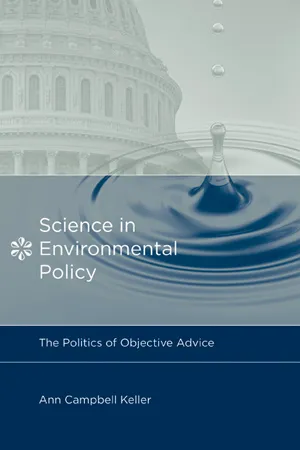
Science in Environmental Policymaking
Ann Campbell Keller Science in Environmental Policymaking: The Politics of Objective Advice MIT Press 304 pages, 9 x 6 inches ISBN 978 0262512961
Available here →November 16, 2009
20091116-keller-ann-on-science-environmental-policymaking-politics-advice-3
A close-up
The rest of this thread

Peg Skorpinski
Ann Campbell Keller
Ann Keller is an assistant professor at the UC Berkeley School of Public Health. She holds a Ph.D. in political science from UC Berkeley and was a postdoctoral fellow with the Robert Wood Johnson Scholars in Health Policy Research Program. Keller is currently working on an NSF-funded study to analyze the organizational and analytic challenges of responding to global infectious disease outbreaks. Her research appears in the Journal of Public Administration Research and Theory, Public Administration Review, Frontiers in Ecology and the Environment, and The Nonproliferation Review.
Pull this thread
Scientists may advocate during agenda setting, where framing power sits, and are disciplined into objectivity as policy formalizes.
Know something the rest of us don't?
Most threads on Rorotoko begin with our invitation. Any thread can begin with a proposal: you write it with the same prompts every thread answers, and we review it.
Propose a thread →