
Gregory D. Koblentz
Living Weapons
Biological weapons are the least well understood of the so-called weapons of mass destruction, or WMDs. Despite the growing awareness of the threat posed by biological weapons, the history of biological warfare and the unique security challenges posed by biological weapons remain unfamiliar to much of the public, academia, and government.
During the cold war, the focus on nuclear weapons was understandable. The destructive power of nuclear weapons had been established with horrific results during World War II, and postwar advances generated even more powerful weapons. Nuclear weapons formed the core of the superpowers’ strategic arsenals and were integral to maintaining the “balance of terror” between them. In addition, these weapons were deployed or under development in zones of potential conflict stretching from Europe to the Middle East to Asia.
In contrast, biological weapons have never been used openly on the battlefield and their development has always been conducted under the strictest secrecy. In addition, in 1969 the United States abandoned its offensive BW program, and in 1972 biological weapons became the first class of weapons to be completely outlawed by an international treaty, the Biological Weapons Convention (BWC). Thereafter, biological weapons, never high on the list of priorities, slipped even lower. Biological weapons, however, did not disappear with the signing of the BWC.
The international security implications of the biotechnology revolution and the spread of biological weapons began receiving increased attention in the 1990s following revelations about the Soviet and Iraqi BW programs, continued advances in the life sciences, and the emergence of more lethal terrorist groups interested in weapons of mass destruction. This renewed attention, however, has not always translated into a greater understanding of the dangers posed by biological weapons. Government officials and academics frequently lump biological weapons together with nuclear and chemical weapons under the category of WMD or discuss the “chem-bio” threat.
Terms such as WMD and “chem-bio” have hindered our understanding of the international security implications of biological weapons. The widespread use of these labels has obscured important differences between these different weapons and the strategic consequences of their proliferation.
Unlike nuclear and chemical weapons, biological weapons are composed of, or derived from, living organisms. This unique characteristic of biological weapons is at the heart of many of the security challenges posed by them. The diversity of pathogenic microorganisms and toxins that can be used as weapons provides the attacker with flexibility in planning its attack. The sheer number of potential biological warfare agents complicates the task of the defender. The ability of pathogens to replicate themselves inside a host enables an attacker to use only a small amount of a biological weapon to inflict mass casualties. The overlap between the equipment, knowledge, and materials required to develop biological weapons and to conduct civilian biomedical research or develop biological defenses limits the effectiveness of arms control and verification measures and complicates intelligence collection and analysis.
The study of biological weapons reveals a number of paradoxes and dilemmas. Biological weapons are widely feared, yet rarely used. Biological weapons were the first weapon prohibited by an international treaty, yet the proliferation of these weapons increased after they were banned in 1972. Biological weapons are frequently called “the poor man’s atomic bomb,” yet they cannot provide the same deterrent capability as nuclear weapons. One of the goals of my book is to explain the underlying principles of these apparent paradoxes.
Editor: Erind Pajo
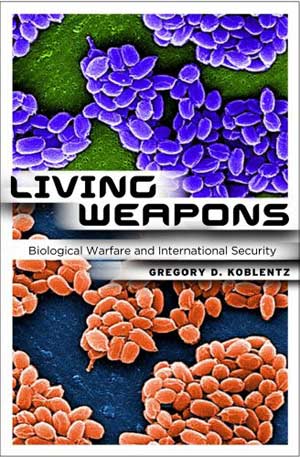
Living Weapons
Gregory D. Koblentz Living Weapons: Biological Warfare and International Security Cornell University Press 255 pages, 9 x 6 inches ISBN 978 0801447686
Available here →November 23, 2009
20091123-koblentz-gregory-on-living-weapons-biological-warfare-security-2
The wide angle
The rest of this thread

Gregory D. Koblentz
Gregory D. Koblentz is an Assistant Professor in the Department of Public and International Affairs and Deputy Director of the Biodefense Graduate Program at George Mason University. Dr. Koblentz is also a Research Affiliate with the Security Studies Program at the Massachusetts Institute of Technology and a member of the Scientist Working Group on Chemical and Biological Weapons at the Center for Arms Control and Non-Proliferation in Washington, DC. His research and teaching focus on international security, terrorism, homeland security, and weapons of mass destruction. In addition to Living Weapons, Dr. Koblentz is the co-author of Tracking Nuclear Proliferation (Washington: Carnegie Endowment for International Peace, 1998). He has also published articles in International Security, Nonproliferation Review, Arms Control Today, and Jane’s Intelligence Review.
Pull this thread
Biological weapons are not like nuclear or chemical weapons, because they are living things.
Know something the rest of us don't?
Most threads on Rorotoko begin with our invitation. Any thread can begin with a proposal: you write it with the same prompts every thread answers, and we review it.
Propose a thread →