
Robert E. Hegel
True Crimes in Eighteenth-Century China
My book presents a sample of crime reports from eighteenth-century China in English translation. All are capital crimes. Since all capital crimes might carry the death penalty, detailed reports of all levels of investigation had to be forwarded to the Emperor for his final decision on sentencing. Capital crimes required investigation and review at local, prefectural, provincial, and central levels of the imperial Qing period (1644-1911) administration. These reports include information about the victims and what happened to them, testimony from the accused and various witnesses, and official correspondence between judicial officials about the crimes.
They are not fiction, but they make for interesting reading for modern readers in two ways. First, they document all too common human mistakes and weaknesses—most seem like the kinds of crimes we might read about in our daily newspapers. (Only the political crimes appear to be unique to their time and place.)In addition, these cases show how justice was sought through the art of writing: certain information was emphasized and other information was downplayed in order to support the verdict reached by the magistrate after his investigation. There was no jury; the interpretation of the evidence was left up to the local magistrate. But he had to convince a series of judicial reviewers—including the Emperor in Beijing—that he had fulfilled his obligations to get all the facts and to judge them fairly and accurately. If a perpetrator later recanted testimony that he or she had been wrongly forced to make, or if the magistrate had not discovered the whole truth, the magistrate could be punished by losing his position, being forever barred from holding office, or being physically punished and fined. All of the judicial reviewers were also regularly examined for any dereliction of duty; they, too, could be severely punished for interfering with justice.
These cases demonstrate the workings of a judicial and legal system very different from that of modern Western nations. But the administration of justice in imperial China also sought fairness, just as we do today, and the system incorporated many levels of safeguards for the accused. Like our own jury system, this system relied heavily on the basic goodness of individuals to make it work. I hope that my readers will get a better sense of how a common human problem—the punishment of perpetrators of major crimes—has been understood and dealt with in another culture, in another time, with unfamiliar concepts of law and criminal investigation.
Editor: Erind Pajo
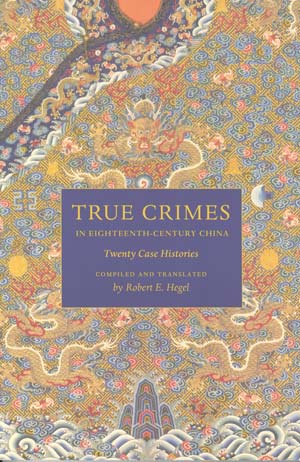
True Crimes in Eighteenth-Century China
Robert E. Hegel True Crimes in Eighteenth-Century China: Twenty Case Histories University of Washington Press 285 pages, 9 x 6 inches ISBN 978 0295989075
Available here →December 18, 2009
20091218-hegel-robert-on-true-crimes-18th-century-china-case-histories-1-1
In a nutshell
The rest of this thread

Marvin Marcus
Robert E. Hegel
For the last 35 years Robert E. Hegel has taught at Washington University in St. Louis, currently as Liselotte Dieckmann Professor of Comparative Literature and Professor of Chinese. His research centers on imperial China’s fiction, especially from the period of 1500 to 1900, when the novel and short story came of age. His first book surveys novels of the century of transition between China’s last two dynasties; his second, Reading Illustrated Fiction in Late Imperial China, explores the book as commercial object and the development of reading and writing practices. His many articles address narratives of all kinds, including, most recently, legal texts.
Pull this thread
The Qing legal system was a working attempt at fairness, with layered safeguards and real penalties for failing judges.
Know something the rest of us don't?
Most threads on Rorotoko begin with our invitation. Any thread can begin with a proposal: you write it with the same prompts every thread answers, and we review it.
Propose a thread →