
Robert E. Hegel
True Crimes in Eighteenth-Century China
There are many cases in my book that should be of particular interest to an inquisitive reader wanting to find out what happened, why, and what the punishment might have been: the two cases involving men who killed their own brothers, one over a few pounds of beans beyond what was needed for consumption and another over manure for fertilizing the fields; the neighbors whose frustrations resulted in flashes of anger that caused irreparable damage, one over an outhouse, another over water for irrigation. Or perhaps the reader would happen on a case involving adultery, reading on to find out how the affair began, and how it reached its inevitably tragic outcome—since only those cases that ended in homicide appear in my sample of cases. There are moral lessons to be learned here, of course (then, as always, alcohol abuse all too frequently led to disaster), but there are greater human truths as well. Not all brothers get along well; there can be jealousy, misunderstandings, hurt feelings from childhood that still linger decades later, and mistreatment that cannot be spoken about openly but that leaves its scars and its acute sensitivities. Adultery can be provoked by more than just sexual desire; differences in power relations between the genders and between people of different status levels led to violence in Qing society just as often as they have in others. Much is left unsaid in many of these cases. Was the act that spurred the violence really the “last straw,” the last of a series of insults, intended or accidental, that pushed the perpetrator beyond the breaking point? Was the magistrate really interested in the whole truth, or merely what he needed to build a persuasive case? I can not help wishing that more questions had been asked—but the reports are limited to information immediately relevant to the crime. And to what extent should we all be responsible for what happens to our neighbors—or even our brothers? Were there really different obligations to be fulfilled in that very different culture, now 250 years old? There is no speculation on human values incorporated into these crime reports; however, standards for behavior can be inferred from the penal codes that stipulated a specific punishment for every type of crime, distinguished by the relationships between the perpetrator and his or her victim. This may be a world of the past, but Qing China comes alive through the misadventures of some of its least distinguished subjects. As a reader of fiction, I was drawn not only to how the “stories” here were told, but even more to what those stories had to say about specific individuals and about humanity in general. My hope is that other readers can empathize with these people, relating to them as neighbors from another time rather than representatives of some strange, foreign culture now long gone. If we can view the judicial system of late imperial China as a viable attempt to reach goals that we share today, then we can overcome the prejudiced view of early twentieth-century reformers and we can more objectively regard China’s past as an important segment of our common human experience. By doing so, we can more easily see the common human needs at work then, and we can more fairly judge the accomplishments of that time and place. In creating this compilation, I wanted to provide my undergraduate students of Chinese literature and culture a means to get beyond the generalizations, the welter of dates, and the names of numerous dynasties and poets through time. I wanted them to appreciate something of the messy reality of lived experience.
Fiction is often seen as a viable means to that end. And it may be a valuable window into a culture. But in the end fiction is made up for a purpose—which in imperial China was never to provide an accurate description of the author’s society or of any particular real person. Legal reports tell the sad stories of real people who got into very real trouble and, at least to some extent, the reasons why they did so. These criminals were not exemplary figures, nor were they either typical or even fully unique. Human mistakes are human mistakes, and that is what is shown by these cases. I also want to provide people who are interested in law and criminal justice a sample of these hard-to-access materials. Until recently, there were no translations of such case reports. The originals were all in archives in Beijing and Taipei, carefully preserved, but, even for scholars, difficult to reach. My hope is that with a better understanding of alternative visions of working criminal justice systems, specifically of the courts of long-gone imperial China, those of our own time might be better understood, and perhaps perfected.
Editor: Erind Pajo
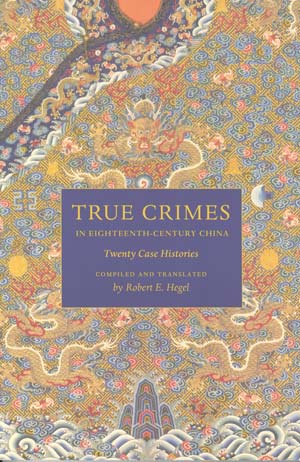
True Crimes in Eighteenth-Century China
Robert E. Hegel True Crimes in Eighteenth-Century China: Twenty Case Histories University of Washington Press 285 pages, 9 x 6 inches ISBN 978 0295989075
Available here →December 18, 2009
20091218-hegel-robert-on-true-crimes-18th-century-china-case-histories-3
A close-up
The rest of this thread

Marvin Marcus
Robert E. Hegel
For the last 35 years Robert E. Hegel has taught at Washington University in St. Louis, currently as Liselotte Dieckmann Professor of Comparative Literature and Professor of Chinese. His research centers on imperial China’s fiction, especially from the period of 1500 to 1900, when the novel and short story came of age. His first book surveys novels of the century of transition between China’s last two dynasties; his second, Reading Illustrated Fiction in Late Imperial China, explores the book as commercial object and the development of reading and writing practices. His many articles address narratives of all kinds, including, most recently, legal texts.
Pull this thread
The Qing legal system was a working attempt at fairness, with layered safeguards and real penalties for failing judges.
Know something the rest of us don't?
Most threads on Rorotoko begin with our invitation. Any thread can begin with a proposal: you write it with the same prompts every thread answers, and we review it.
Propose a thread →