
Wafaa Bilal
Shoot an Iraqi
Here in the U.S. we read and watch the news of countless deaths in Iraq and other war-torn countries around the world. We briefly take note of the incidents, sometimes we might even read a name or glance at a photo. But it is rare that we ever visualize the death, the moments that led up to it and follow it, the way it ripples out across families and even down through generations.
I myself had this same experience when my brother Haji was killed in Iraq. It was shattering and at the same time remote. It wasn’t until three years later, in the midst of my Domestic Tension performance art project, that the loss really hit me. Take these excerpts from the book:I can’t hold it in anymore. In a wave of despair, I realize I truly will never see my father or brother again.
I crawl over to the desk behind the paint-splattered plexiglass screen so I can cry without them seeing me. I set my video camera, recording everything, on top of the desk aimed up at my face, determined to document myself even as I am sinking into a black hole of grief. I sob. Tears stream down my face and catch in my beard; my face contorts in pain; small moans like a child’s escape from my twisted lips. I haven’t cried like this since they died.
With all the physical and mental exhaustion, I can no longer keep up the barriers that had been holding everything back.
To the camera, I say, “This project has allowed me to deal with things I had avoided for a long time, the loss of my brother and my father, my family, I miss them terribly. I miss home!”
My brother had his entire future in front of him. He was only in his mid-20s, and he had gotten married just a year ago. He was supporting the family with the thriving business he had started with a cousin. They sold gravel and sand from our family land in the dry Sea of Najaf to construction contractors. The Bilal family owned a large tract of land in this ancient sea, now a barren flatland too rocky and parched for farming, abutting the famous Najaf cemetery. Our relatives had refused to give our immediate family our rightful share of the land. Haji was so tough and strong, much more so than me and the other brothers.
He walked with a swagger and literally had his gun on his hip at all times. So he confronted a top man in the tribe and convinced him to turn over the land. My family lived in a really rough neighborhood, it made the south side of Chicago look like a picnic. Even before the war, you would see people shot and slaughtered on a regular basis. So you had to be tough to survive there, and Haji was one of the toughest.
Moqtada al Sadr’s headquarters were in Kufa and Najaf. As U.S. troops were advancing toward the city, his Mahdi Army put out a checkpoint of tough guys on the other side of the river to stop them. Al Sadr’s people came to the house and put pressure on Haji to man this checkpoint at the Kufa Bridge.
My mother and Ahmed said there’s no way you’re going. But there was a lot of pressure on him to go out and man that checkpoint. He was close with al Sadr’s men, and he didn’t want to appear weak. When I had talked to him on the phone he was using words I could tell would lead to no good, talking about the “invaders” – the U.S. – and how he would resist them. I had told him to stay away from al Sadr’s people, but of course he didn’t listen.
During and after my Domestic Tension project, the post traumatic stress disorder I had suffered intensely in my early years in the U.S. resurfaced with a vengeance. This is not surprising given the experience of literally being under the gun, confronting the loss of my brother and my father and experiencing the hate and rage—as well as support and care—of viewers and participants. PTSD and its confusing and wide-ranging effects became one of the central themes of my project. Already PTSD among American soldiers has become a high profile topic and concern, but I know we have only begun to see what will ultimately be a tidal wave of emotional trauma washing back over the U.S. as our troops return home from wars in Iraq, Afghanistan and elsewhere. Given my own experience with PTSD, I am deeply afraid of the consequences for individuals, families and society as a whole.
My Domestic Tension project and my larger story provoke readers, I hope, to not only see the ground-level effects of war abroad, but to see Iraqis and regular Americans as victims and pawns in power plays beyond their individual control. People everywhere need to better understand the impacts and results of such wars and foreign policies. I can only hope that through dialogue and collective action, we can do something.
Editor: Erind Pajo

Shoot an Iraqi
Wafaa Bilal and Kari Lydersen Shoot an Iraqi: Art, Life and Resistance Under the Gun City Lights 240 pages, 8 1/2 x 6 inches ISBN 978 0872864917
Available here →December 25, 2009
20091225-bilal-wafaa-on-shoot-an-iraqi-art-life-resistance-under-gun-lyders-3
A close-up
The rest of this thread
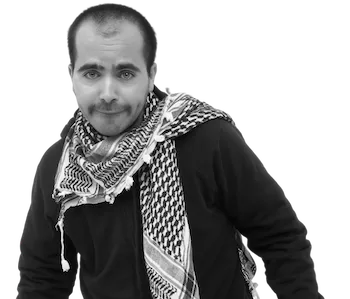
Wafaa Bilal
Wafaa Bilal exhibits worldwide and is an assistant professor at New York University’s Tisch School of the Arts. The Chicago Tribune named him Artist of the Year in 2008, calling his dynamic installation featured in this Rorotoko book interview “one of the sharpest works of political art to be seen in a long time.” Shoot an Iraqi was also named as one of the top 10 arts books of the year by Booklist. Bilal’s coauthor, Kari Lydersen, is a staff writer for The Washington Post, and also author of other books, including Revolt on Goose Island: The Chicago Factory Takeover and What it Says About the Economic Crisis (Melville House, 2009). More about Lydersen can be read on her site.
Pull this thread
The distance Americans keep from deaths in Iraq is manufactured, not natural.
Know something the rest of us don't?
Most threads on Rorotoko begin with our invitation. Any thread can begin with a proposal: you write it with the same prompts every thread answers, and we review it.
Propose a thread →