
Amanda Goodall
Socrates in the Boardroom
Socrates in the Boardroom argues that it is experts, not managers that make the better leaders. This is a message that, recently, has been almost unfashionable. I go a step further: using quantitative and qualitative data, I show that in universities it is the best of the experts and scientists who make the best leaders.
I use the example of university leadership to try to communicate that managers have been given too much power—not just in organizations such as universities and hospitals, also in the corporate sector.
Specialists, experts and scientists should lead our institutions if we want to boost our economies through innovation and entrepreneurship, and solve problems like climate change.
In the last half of the 20th century the importance of management training became recognized. As society moved away from predominantly family-owned businesses and employment through entitlement to a more meritocratic and efficient approach to enterprise, good management was crucial. Business schools took off, as did the MBA degree.
But this move has gone too far. At present, managerialism feels preeminent—as if expertise is not important. Could the banking crisis have been somewhat averted if bank CEOs were great technical experts instead of good managers? They might have better understood what was going on in the belly of their organizations if they were banking specialists, but many were not.
My main message is that leaders should be experts in the core business of the organization they are to lead.
This is not to say that management is unimportant. Of course it is. But I believe we need to get back to basics. There has been a trend for CEOs to float around different sectors—as if a head’s success when in charge of a retail business automatically means that the same individual can lead a manufacturing company. I find that a hospital should be lead by a doctor and an automobile company should be led by someone who knows the industry and the technology intimately. This might indeed mean that the CEOs who are accountants and marketing specialists return to their fields of expertise—accounting and marketing.
Though the main focus of my book lies with the research universities, I also look at other sectors. In chapter 7, for example, I look at professional service firms such as law, management consulting and architecture practices, as well as at arts and sports. Here, including evidence from a co-authored paper, I show that teams perform substantially better in the NBA if they are led by a coach who was, in his day, an outstanding player.
Editor: Erind Pajo
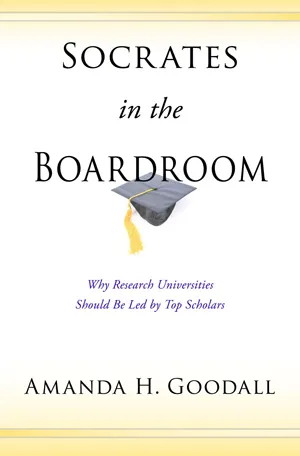
Socrates in the Boardroom
Amanda Goodall Socrates in the Boardroom: Why Research Universities Should Be Led by Top Scholars Princeton University Press 208 pages, 9 x 6 inches ISBN 978 0691138008
Available here →December 30, 2009
20091230-goodall-amanda-socrates-boardroom-research-universities-lead-1-1
In a nutshell
The rest of this thread

Lawrence Trainor
Amanda Goodall
Amanda Goodall left high school at 16 and worked as a fashion model until the mid 1980s. She then lived in India on a small development project, and for a number of years worked with campaigning organizations back in the UK. At age 33 Amanda went to university—the London School of Economics—and graduated with a first-class honors degree. Following the degree she worked with Anthony Giddens, director of the London School of Economics, as part of the top management team, and later with the president of Warwick University. In 2004 Amanda started a Ph.D. at Warwick Business School which she completed in 2007. She is currently a Leverhulme Fellow located at Warwick Business School in the UK. Recently she has held Visiting Fellowships at Cornell University and the University of Zurich. Her work is available at www.amandagoodall.com.
Pull this thread
In organizations built on expert knowledge, experts make better leaders than managers.
Know something the rest of us don't?
Most threads on Rorotoko begin with our invitation. Any thread can begin with a proposal: you write it with the same prompts every thread answers, and we review it.
Propose a thread →