
Amanda Goodall
Socrates in the Boardroom
Why do experts make better leaders?
I interviewed twenty-six presidents and deans in universities in the US and UK, including Amy Gutmann at U Penn, Lawrence Summers and Derek Bok, former Harvard presidents, David Skorton at Cornell, John Hood at Oxford, Patrick Harker at the Wharton School, and others.
Four reasons why top scholars should lead research universities emerged from these interviews.
First, a president who is a distinguished scholar will have a better understanding of the core business of a university, that of research and teaching. This is central to the idea of “expert leadership,” that in organizations where the core business relies on expert knowledge the leader must first be an outstanding expert in the relevant area of business. This challenges the ideas of managerialism that would appear to promote management skills above expert knowledge. Arguably, top scholars, engineers or lawyers must also have management and leadership skills, and in my dataset of 400, almost all the leaders had progressed through managerial hierarchies in their institutions prior to the top job.
A second explanation raised by interviewees, one that again relates to expert knowledge, is that a scholar-leader will likely demand higher academic standards. Arguably, it is leaders who should set the standards in any organization. This message is articulated by a dean in one of my interviews: “leaders are the final arbiters of quality. Therefore it is right to expect the standard bearer to first bear the standard.”
Top scholars send out important signals to a number of audiences. That was the third explanation from interviewees. They signal a university’s priorities, act as a beacon when hiring other outstanding academics, and, it was argued, are attractive to students and donors.
Finally, it was suggested that scholars are more credible leaders. A president who is a researcher will gain greater respect from academic colleagues and appear more legitimate. Legitimacy extends a leader’s power and influence. So if the board of a research university wants to improve its performance in what I consider is the “core business” of research and teaching, then they should hire great scholars as leaders. And, as discussed in chapter 7, this is also relevant to heads in law and accounting firms, in R&D, management consultancies and architecture practices, and the creative industries.
Universities are among society’s oldest and most respected organizations. If scholars are so bad administrators, why have universities done so well, often against odds like decreasing funds and more than occasional outside interference?
One might think that managerialists have led a sort of conspiracy against experts and specialists. Time and time again whilst undertaking my research I was told that academics do not make good managers or leaders. This opinion, often stated vociferously, came from a number of academics, administrators and those outside universities, including politicians, civil servants and business people. The president of a powerful US university once said it to me, and I have heard it from individuals who have barely stepped foot in a university.
The opinion has reached folklore proportions. When I ask for evidence, academics will often tell anecdotal stories about a former department chair. Among those outside the academy there appears to be a general belief that people clever enough to be academics must lack normal human organizational abilities.
I often respond to these claims by posing a scenario: imagine that 100 nurses and the same number of lawyers, chefs, advertising executives, engineers, journalists and academics are randomly selected. Will we find that one group or profession stands out as natural managers? Is it not more likely that management skills are learned through training and experience? And that, even if leadership may be somewhat different, the propensity to manage is, approximately, evenly distributed across all professions?
Universities could be accused of being poor at training their faculty in management and leadership. In research universities, it is usual for departmental heads to rotate every few years, and it is common for a professor to walk—or be dragged—directly into the job with no prior instruction. But this is a different argument.
So my plea is to bring experts and specialists back into leadership positions in our major public and private institutions.
Editor: Erind Pajo
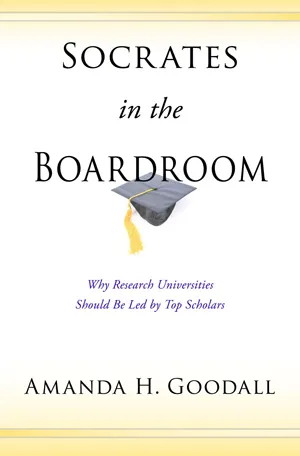
Socrates in the Boardroom
Amanda Goodall Socrates in the Boardroom: Why Research Universities Should Be Led by Top Scholars Princeton University Press 208 pages, 9 x 6 inches ISBN 978 0691138008
Available here →December 30, 2009
20091230-goodall-amanda-socrates-boardroom-research-universities-lead-3
A close-up
The rest of this thread

Lawrence Trainor
Amanda Goodall
Amanda Goodall left high school at 16 and worked as a fashion model until the mid 1980s. She then lived in India on a small development project, and for a number of years worked with campaigning organizations back in the UK. At age 33 Amanda went to university—the London School of Economics—and graduated with a first-class honors degree. Following the degree she worked with Anthony Giddens, director of the London School of Economics, as part of the top management team, and later with the president of Warwick University. In 2004 Amanda started a Ph.D. at Warwick Business School which she completed in 2007. She is currently a Leverhulme Fellow located at Warwick Business School in the UK. Recently she has held Visiting Fellowships at Cornell University and the University of Zurich. Her work is available at www.amandagoodall.com.
Pull this thread
In research universities the best scholars make the best leaders, and a hospital should be led by a doctor.
Know something the rest of us don't?
Most threads on Rorotoko begin with our invitation. Any thread can begin with a proposal: you write it with the same prompts every thread answers, and we review it.
Propose a thread →