
Joyce Appleby
The Relentless Revolution
I’d like my fresh reader to read the introduction carefully because it lays out my argument and makes the assertions that the text must back up. Many believe that capitalism was an inevitable development and that it had deep roots in European intellectual soil. In my introduction I explain why I don’t think that either is true. I would like my reader to give careful attention to how the Four Little Tigers of South Korea, Taiwan, Singapore, and Hong Kong became important players in the world market, for their differences underscore my point that capitalism takes different shape in different countries because it is a culture and cultures encompass family mores, religion, politics, and personal values. Capitalism has also been treated as though it were a natural system like aerodynamics with its own laws.
The argument against this view runs through The Relentless Revolution. Knowing the fascinating history of how capitalism emerged within a traditional society and succeeded in challenging venerable orders throughout the world, I would hope, would open people to new ways of thinking about their economy.
Capitalism may be a relentless revolution, but it is not a mindless one. Pervasive poverty, global warming, failed states, and oppressive governments still present problems for the world. The wealth-generating capacity of capitalism can help meet all of these challenges. But, first, we must understand it.
Editor: Erind Pajo
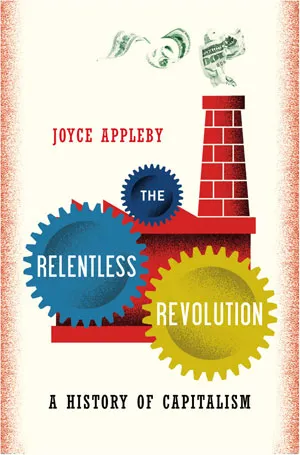
The Relentless Revolution
Joyce Appleby The Relentless Revolution: A History of Capitalism W. W. Norton 496 pages, 9 x 6 inches ISBN 978 0393068948
Available here →January 6, 2010
20100106-appleby-joyce-on-relentless-revolution-history-capitalism-3
A close-up
The rest of this thread

Joyce Appleby
Joyce Appleby is a professor emerita of UCLA where she taught American history for 20 years. Her abiding interest has been in analyzing the changing social theories about human nature, politics and economic development that accompanied the modern transformation of Europe and America. She is a past president of the American Historical Association, the Organization of American Historians, and the Society for the History of the Early Republic, and is currently co-director of the History News Service, an informal syndicate of professional historians who write newspaper op-ed essays that put contemporary issues in their historical context. Her most recent publications are Inheriting the Revolution: The First Generation of Americans (2000), Jefferson (2003), a collection of addresses and essays titled A Restless Past: History and the American Public (2004), and The Relentless Revolution: A History of Capitalism (2010).
Pull this thread
Capitalism is a culture, not a natural or inevitable economic system.
Know something the rest of us don't?
Most threads on Rorotoko begin with our invitation. Any thread can begin with a proposal: you write it with the same prompts every thread answers, and we review it.
Propose a thread →