
Joyce Appleby
The Relentless Revolution
The Relentless Revolution begins with the puzzle of why it took so long for capitalism to emerge. Defining capitalism as a cultural system based on a particular economy, I show that capitalism was never just an economic system. Its focus on enhancing production through private initiatives impinged on every facet of life and was itself affected by every institution that shaped its participants.
Capitalism created new cultural forms, stimulated new tastes, and introduced a whole new vocabulary for discussing the impact of private enterprise on the welfare of the society as a whole. In time, traditional ways of acting and thinking lost their controlling power.
Neither inevitable nor predictable, capitalism began with a few innovations. In 17th century England, new ways to produce food made possible reducing the number of men and women required to feed the society. Capital too was released for investments in things like the steam engines that were revolutionizing mining and manufacturing. The new science promoted an unending succession of technological advances. Over the next century the percentage of population devoted to farming dropped from around 80% to 40%. This was a first in world history.
Once capitalism’s amazing power to generate wealth was detected, most countries, at least in the West, wanted part of the action. In the 18th century, it was relatively easy for other countries to copy English innovations. The United States and Germany overtook England by the end of the 19th century.
Following the trajectory of capitalist expansion, The Relentless Revolution shows why capitalism is a cultural system. Where commerce could live within the interstices of society with its customary mores and aristocratic habits, the capitalist system forced widespread social and political change because its momentum involved more and more of society’s population. For this reason, there are in today’s world many variants of capitalist culture as different nations align economic restructuring with the basic qualities of their people.
Editor: Erind Pajo
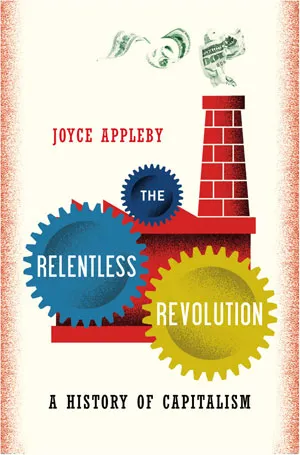
The Relentless Revolution
Joyce Appleby The Relentless Revolution: A History of Capitalism W. W. Norton 496 pages, 9 x 6 inches ISBN 978 0393068948
Available here →January 6, 2010
20100106-appleby-joyce-on-relentless-revolution-history-capitalism-1-1
In a nutshell
The rest of this thread

Joyce Appleby
Joyce Appleby is a professor emerita of UCLA where she taught American history for 20 years. Her abiding interest has been in analyzing the changing social theories about human nature, politics and economic development that accompanied the modern transformation of Europe and America. She is a past president of the American Historical Association, the Organization of American Historians, and the Society for the History of the Early Republic, and is currently co-director of the History News Service, an informal syndicate of professional historians who write newspaper op-ed essays that put contemporary issues in their historical context. Her most recent publications are Inheriting the Revolution: The First Generation of Americans (2000), Jefferson (2003), a collection of addresses and essays titled A Restless Past: History and the American Public (2004), and The Relentless Revolution: A History of Capitalism (2010).
Pull this thread
Capitalism is a culture, neither inevitable nor natural, so it takes a different shape in every country that adopts it.
Know something the rest of us don't?
Most threads on Rorotoko begin with our invitation. Any thread can begin with a proposal: you write it with the same prompts every thread answers, and we review it.
Propose a thread →