
Joseph Margolis
The Arts and the Definition of the Human
In the Prologue to my book, I offer a summary of my theory of the human self and explain the conceptual linkage between the definition of the human and the theory of what it is to engage the arts in ways that depend on visual perception and on understanding what we read. In the Epilogue, I try to locate the book's contribution, within its niche in the history of Western philosophy.
My thought is that “modern” modern philosophy really “begins” with Immanuel Kant’s introduction of his “transcendental” question—here applied to our perceiving paintings and understanding literature. This proved to be a transformative moment in Western philosophy. Kant's question, “How is ______ possible?” (for instance, scientific knowledge or moral judgment; and now, here, the perception of paintings and the understanding of literature) proves to be surprisingly complex, stubborn, but inescapable. This is a question on which the whole of philosophy, and in a sense every form of rational inquiry, depends.
And yet, Kant's own application of his transcendental question proved to be inadequately examined (by Kant himself) and, ultimately, indefensible in the form he originally advanced.
It had to be corrected in a deep way, and was, magisterially, though problematically, by the so-called Idealist tradition that culminates in the work of Hegel, roughly signifying the historicizing and cultural penetration of all our inquiries. This, at any rate, is how I read matters. The inseparable contributions of Kant and Hegel, interpreted in endlessly inventive ways, provide the largest, most instructive philosophical vision within which all of the most promising questions of current philosophy make their useful contribution. The analysis I offer fits congruently within the most central tradition of philosophical speculation that modern Western thought has as yet produced.
The book is a short one; the issue I raise requires a fresh beginning and a clear sense of the philosophical world to which my argument and analysis rightly belong. Viewed in a wider context, The Arts and the Definition of the Human is but a single piece in a larger philosophical venture, one meant to explore the viability and attraction of a picture of the world. This massive undertaking is not a chaos, but a flux, an order of things that is never fixed or changeless, yet regular enough to support all our sciences and inquiries and projects, enabling us to understand our special talents in mapping the world's properties. There is no completely formulated and developed version of this sort, though there have been brief efforts along these lines both in the ancient world and in modern times.
The implications of such a conception are very different from those of views committed to one or another form of invariance or necessity. Suppose, for instance, that the world does not obey changeless and exceptionless laws, or that what we count as a true science, at every point of contested discovery, is itself a construction of our own, provisionally favored in accord with our historied interests, which are themselves bound to be replaced by interests answering to the changing features of the world we know. I don't pretend to determine whether the world is a flux or depends on some ultimate invariance. I think we must decide for ourselves, however, if the conception of a fluxive world can compete effectively with the usual commitment to invariance. Thinking along such lines could change our picture of the world and our belief that we may rightly judge whether our ventures are rational and defensible or not.
Editor: Erind Pajo
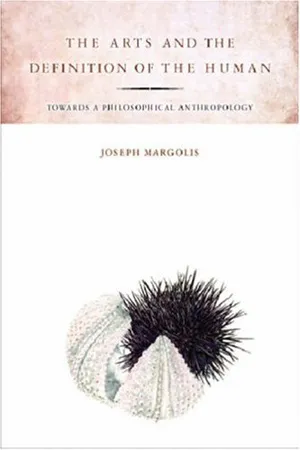
The Arts and the Definition of the Human
Joseph Margolis The Arts and the Definition of the Human: Toward a Philosophical Anthropology Stanford University Press 200 pages, 9 x 6 inches ISBN 978 0804759540 ISBN 978 0804759533
Available here →January 11, 2010
20100111-joseph-margolis-on-arts-definition-human-philosophical-anthropolog-3
A close-up
The rest of this thread
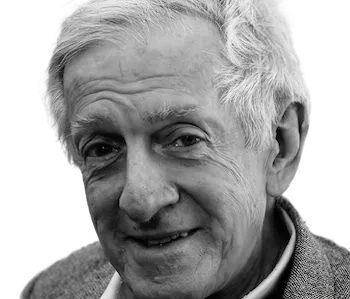
Joseph Margolis
Joseph Margolis is currently Laura H. Carnell Professor of Philosophy at Temple University. He has completed sixty years of university teaching and has taught very widely throughout the United States, Canada, and other parts of the world, including South Africa, New Zealand, and Sweden. He’s published almost forty books ranging over nearly all the principal specialties of philosophy. Most recently, he completed a trio of books on American philosophy in the second half of the 20th century, with special emphasis on the past and future of pragmatism within the Eurocentric tradition.
Pull this thread
You cannot explain how anyone sees a painting or understands a novel without first settling what a self is.
Know something the rest of us don't?
Most threads on Rorotoko begin with our invitation. Any thread can begin with a proposal: you write it with the same prompts every thread answers, and we review it.
Propose a thread →