
Kay Heath
Aging by the Book
Midlife anxiety thrived in other forms of Victorian print culture as well. One good example is soap advertisements. At mid-century, an array of mass produced products were put on display at the Crystal Palace exhibition, and Victorians learned the joys of consumerism. As advertising expanded and national brands began to appear, Francis Pears’s partner, Thomas Barratt, created innovative marketing strategies to sell soap. Advertising Pears for many uses—a gentle cleanser for children, a shaving soap for men—he focused on women as consumers interested in combating age.
Barratt uses a variety of strategies in his advertisements to promote soap as an anti-aging treatment. He incorporates testimony from a “most eminent authority of the skin, Professor Erasmus Wilson,” who promises that “a good soap is certainly calculated to preserve the Skin in health, to maintain its complexion and tone, and prevent its falling into wrinkles.”
Scholars have written about racism in his ads that depict black children washed white, but Barratt also conflates race with age. For example, in one ad, a dying Aboriginal man dreams of being reborn with young, white skin, the Pears logo floating on the horizon. In other campaigns, Barratt ran ads featuring youthful, notorious women. Lillie Langtry, an actress and mistress of several prominent men, including the Prince of Wales, appeared in ads promising to “preserve” the skin. The infamous Georgina Weldon, a singer and amateur lawyer who successfully sued her husband for trying to commit her to a madhouse, starred in an 1888 campaign. Looking up demurely from under her bonnet, Weldon claims, “I am 50 today, but thanks to Pears’ Soap my complexion is only 17.” Barratt even suggests that his product is powerful enough to win a woman wealth and peerage. A Pears poem presents Mary Ray, the milkman’s daughter, who wisely washes with this soap and ends up marrying a duke, her skin so youthful that at ninety she’s mistaken for “her own grand-daughter.”
Barratt’s success is evident in other soap manufacturers’ imitations of his style. Sunlight Soap followed his lead with headlines such as “How to keep young” and “Why does a woman look old sooner than a man?” Barratt showed manufacturers how to transform a regional product into a nationally branded and lucrative anti-aging beauty commodity, a strategy that both resulted from and strengthened Victorian apprehensions about midlife.
I hope this book not only offers a fresh perspective on Victorian literature but suggests a new way of thinking about age both then and now. Of course, age is a biological fact, but our experiences of it are shaped by our beliefs. To a large degree, these are foisted upon us by culture, by socially-constructed “meanings” that media images and market strategies assign. I want my readers to see aging as a product of culture. Only when we question what we think is natural about aging do we become aware of how our perceptions are formed by societal cues. Only when we are armed with this kind of consciousness, can we overcome ageist stereotypes that cloud our vision and restrict our possibilities.
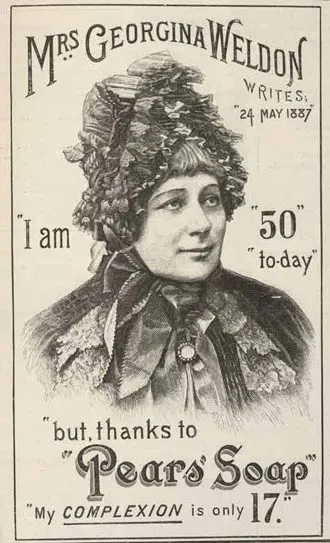
Image courtesy of the Library of Virginia.
Editor: Erind Pajo
Aging by the Book
Kay Heath Aging by the Book: The Emergence of Midlife in Victorian Britain SUNY Press 247 pages, 9 x 6 inches ISBN 978 0791476574
Available here →January 13, 2010
20100113-kay-heath-on-aging-by-book-emergence-midlife-victorian-britain-3
A close-up
The rest of this thread

Kay Heath
Kay Heath is an associate professor of English at Virginia State University. In addition to Aging By The Book, she has published on nineteenth-century aging in Victorian Literature and Culture and Frances Trollope and the Novel of Social Change. Currently, she is working on a project about Victorian women who began writing careers in midlife. Heath was a 2008 recipient of a Mellon Fellowship at the Harry Ransom Center. She received her Ph.D. from Rice University in 2001.
Pull this thread
Midlife anxiety is a Victorian invention, and the word midlife entered an English dictionary in 1895 to name it.
Know something the rest of us don't?
Most threads on Rorotoko begin with our invitation. Any thread can begin with a proposal: you write it with the same prompts every thread answers, and we review it.
Propose a thread →