
Alan Goldman
Transforming Toxic Leaders
In my work with business leaders and their organizations, I bring an active counseling psychology perspective into play, working with executives one-on-one. Naturally, I entertain the possibility that highly intelligent professionals have to struggle at times through everyday conflicts and even personal pathology.
My first “executive case” was in the late 1990s when I worked with a senior manager of a Fortune 500 company, both in individual treatment and on site in his organization. Diagnosed with attention-deficit hyperactivity disorder (ADHD), the manager brought this pre-existing condition into the company with him, infecting his entire division with the disorder.
I had revealed an ADHD manager and an ADHD organization: This spread of a psychological pathogen to employees via the power and influence of the leader is the essence of the concept of “toxicity.” The destructive behaviors inherit in the individual leader’s personality will undoubtedly spread and take their toll on an organizational system.
Transforming Toxic Leaders opens up a broader dialogue and a more differential diagnosis of complex organizational life. Situated at the apex of their organizations, leaders exert profound influence, possessing the power to heal and to wound, to inspire or to bully, to create or destroy. Only by paying close attention to the darker side of toxicity can one boldly investigate the genius CEO who takes a deviant turn when facing his contested child custody case and divorce, temporarily operating out of fear. The CEO orders a vicious, overnight downsizing when his dark personal tragedy is compounded by a collapse on Wall Street and a plunging market share. What is the antidote? In my book, I provide numerous prognoses and remedies in the form of “leadership detoxification.”
Contrary to much behind-the-scenes corporate strategizing, I take issue with the predominantly authoritarian and bullying leadership style enacted during massive corporate downsizings, rightsizings, and layoffs. For example, a coercive and intimidating approach to requiring employees to participate in extensive overtime following a downsizing is a major source of toxicity. Instead, I propose a dialogic relationship-building approach, which is essential to cushion and lessen toxic impact and fallout from a downsizing. Compassionately and genuinely responding to employees’ anger and fear is critical. Emotionally intelligent leadership techniques elicit far more positive employee responses, lower the incidences of grievance and lawsuits, and provide an antidote to the employee perception of widespread abuse.
Beyond detoxification, the implications of this book lie in the arena of the transformation of toxic leadership behaviors into highly functional and intelligent corporate strategy. When one cannot change the one-of-a-kind renowned mitral valve heart surgeon into a doctor with people skills, what are the alternatives? Does one have to eliminate the master surgeon who is the reason for the company’s ranking as a world center for excellence? Or can he be transformed?
By shifting to dual leadership, I helped a highly toxic heart surgeon transform into a super-functional member of the hospital’s family. The treatment was not performed on the doctor, but rather on the organizational system. The surgeon was allowed to concentrate on his technical expertise and incomparable talents in the operating room. Meanwhile, his new leadership partner, also a master surgeon, was assigned to the human-side of the cardiology division, handling the relations between the people there.
What is the moral of the story? Transformation may or may not require a radical reconstruction of the leader in question. With time, patience, and a differential diagnosis I ascertained that by rearranging a few chess pieces the formerly toxic doctor could be placed in a position where he could shine almost all of the time—while his new partner could simultaneously shine via the utilization of his extraordinary people skills.
Without a management fad, a flavor-of-the-month fix, or a purely inspirational ploy, I approach my clients as a professor, a coach and a consultant. I diagnose, intervene and prescribe. The leader or corporation does not always make for a congenial, truthful, or willing patient. Moreover, every chink in the armor of a leader or flaw in corporate policy necessarily points in multiple directions, complicating the picture. A differential diagnosis must replace simple-minded rhetoric and quick-fix leadership schemes. The most dynamic and ingenious of leaders will also have toxic dimensions to his personality and behavior.
Toxicity is a fact of leadership and organizational life. It is little understood but much talked about. It is time to sober up the conversation and take a hard look at human nature, the role of leaders, and the flexibility and resiliency of organizational systems. We must waste less time on the quest for instant fixes, magical surveys and hollow data and metrics. Only by entering the narratives of leadership and corporate life can we walk the road toward positive transformation.
Editor: Erind Pajo
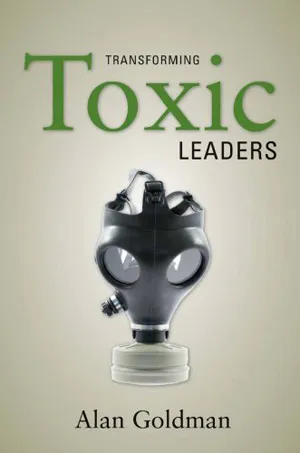
Transforming Toxic Leaders
Alan Goldman Transforming Toxic Leaders Stanford University Press 184 pages, 9 x 6 inches ISBN 978 0804758284
Available here →January 15, 2010
20100115-alan-goldman-on-transforming-toxic-leaders-3
A close-up
The rest of this thread

Alan Goldman
Dr. Alan Goldman is a Professor of Management at the W. P. Carey School of Business at Arizona State University. Goldman’s background includes executive coaching, management consulting, leadership training, and presentations for Fortune 500s and institutions in the U.S., Israel and Japan. He is the author of a variety of academic and professional articles on toxic leaders and dysfunctional organizations. He also served as “Trade Around the World” writer for the first Bush administration’s and Congress’s international publication Five Hundred. He is also the author of Doing Business With the Japanese: A Guide to Successful Communication, Management and Diplomacy (SUNY, 1994), about his cross-cultural consulting in Tokyo.
Pull this thread
Organizational toxicity is a clinical condition that spreads like a contagion, and it is treatable.
Know something the rest of us don't?
Most threads on Rorotoko begin with our invitation. Any thread can begin with a proposal: you write it with the same prompts every thread answers, and we review it.
Propose a thread →