
Alan Goldman
Transforming Toxic Leaders
In my new book Transforming Toxic Leaders I speak from behind closed corporate doors to provide a unique view into the dark side of leadership. Based on executive coaching and consultations I tell surprising stories of companies struggling to understand and remedy what goes wrong. I reveal how the behind-the-scenes fears, hostilities, and internal warfare disclosed by sometimes brilliant leaders require highly personalized and confidential coaching and treatment. I get called in after grievances, acts of sabotage and plunging productivity threaten the very existence of once marquee organizations. Transforming Toxic Leaders calls attention to the high incidence of leaders who bring pre-existing psychological and emotional disorders into their workplace—and how crises eventually bring out the toxic tendencies that were in remission. By telling the true stories of destructive behaviors and agendas I show how leaders turn toxic due to poorly conceived downsizing and abrupt overnight restructuring. The cost of toxic leadership is quite high and the longer it is allowed to germinate the costlier it becomes. Bringing a background in counseling psychology into my coaching and consulting, I train companies to sharpen their toxin detection and toxin handler skills.
I build on a strong theoretical foundation, grounded in research undertaken over the past few decades, and provide tools for action. These are in the form of stories that I’ve selected from my wide repertoire of cases, such as the heart surgeon’s operating team crisis at Eisenhower Heart Institute and the “savage downsizings” at Bentley Pacific and Jarling-Weber. These cases demonstrate ways to better handle problems that may unfold in readers’ own workplaces.
These narratives culminate in a chapter providing a diagnostic list of 125 dimensions of toxic leadership and 125 corresponding strategies for detoxification. Human resource professionals, business managers, and executives seeking to resolve troublesome leader behaviors, hastily conceived restructurings, and employee uprisings will find a wealth of strategies in my book.
Editor: Erind Pajo
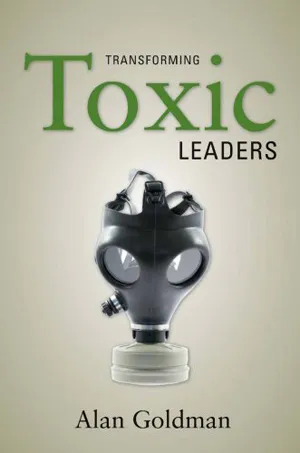
Transforming Toxic Leaders
Alan Goldman Transforming Toxic Leaders Stanford University Press 184 pages, 9 x 6 inches ISBN 978 0804758284
Available here →January 15, 2010
20100115-alan-goldman-on-transforming-toxic-leaders-1-1
In a nutshell
The rest of this thread

Alan Goldman
Dr. Alan Goldman is a Professor of Management at the W. P. Carey School of Business at Arizona State University. Goldman’s background includes executive coaching, management consulting, leadership training, and presentations for Fortune 500s and institutions in the U.S., Israel and Japan. He is the author of a variety of academic and professional articles on toxic leaders and dysfunctional organizations. He also served as “Trade Around the World” writer for the first Bush administration’s and Congress’s international publication Five Hundred. He is also the author of Doing Business With the Japanese: A Guide to Successful Communication, Management and Diplomacy (SUNY, 1994), about his cross-cultural consulting in Tokyo.
Pull this thread
pulls againstpulls alongside
Organizational toxicity is a clinical condition that spreads like a contagion, and it is treatable.
Against LR · Iraq's antiquities were pillaged for structural reasons, and most of the people involved acted in good faith. On: Institutional outcomes are produced by structural design rather than by the qualities of the individuals inside
Against RB · The American trial is dying from the bureaucratic and market structures around it, and that death is not inevitable. On: Institutional outcomes are produced by structural design rather than by the qualities of the individuals inside
Alongside AG · In research universities the best scholars make the best leaders, and a hospital should be led by a doctor. On: Institutional outcomes are produced by structural design rather than by the qualities of the individuals inside
Alongside EB · Imperialism became popular in Britain and France through charismatic heroes, and their charisma was unrelated to accomplishment. On: Institutional outcomes are produced by structural design rather than by the qualities of the individuals inside
Alongside AB · New ideas and leaders, Gorbachev above all, ended the Cold War, and the Soviet Union was never forced to yield. On: Institutional outcomes are produced by structural design rather than by the qualities of the individuals inside
Alongside AP · For a century, children with cameras have ignored what teachers, clubs and Kodak told them to photograph. On: Institutional outcomes are produced by structural design rather than by the qualities of the individuals inside
Know something the rest of us don't?
Most threads on Rorotoko begin with our invitation. Any thread can begin with a proposal: you write it with the same prompts every thread answers, and we review it.
Propose a thread →