
Kelly Oliver
Animal Lessons
Throughout Western history, philosophers have suggested that what is human is determined by what we eat. Whether they think that we are what we eat (like Rousseau and Herder) or that we are not what we eat (like Freud and Kristeva), their notions of humanity either implicitly or explicitly maintain that man becomes human by eating animals.
I begin by looking back at eighteenth-century notions of humanity and animality that define man in terms of what he eats in order to set the stage for an investigation into how more recent philosophers from Freud through Kristeva repeat those romantic gestures that abject animals and exclude them from personhood or humanity, or from consideration as thinking or feeling beings.
I argue that within the history of philosophy, animals remain the invisible support for whatever we take to be human subjectivity, as fractured and obscure as it becomes in the late 20th and early 21st centuries.In Animal Lessons, I distinguish between two types of eating or assimilation that not only speak to our relations with animals, but also our relations with each other.
We can, as humans have for centuries, eat animals (and plants) as a sign of our dominion over the earth and its creatures; we can kill for the sake of conquest and mount our trophies on the wall, dissect them, or train them to jump through hoops. Since we need to eat, a more ethical way to eat others might be to eat only what we need and not more; and to eat in ways that nurture and nourish ourselves, each other—including other animals—and our shared environment. We have a fundamental ethical obligation to others and the earth that sustain us.
The implications of thinking through our relations with animals are vast. Considering animals releases a menagerie of problems that affect almost every aspect of our lives. On the philosophical level, the very conceptions of animal and human, of rights and intelligence are at stake. On the social level, giant global capitalist enterprises such as factory farming and much of the pharmaceutical industry are ventured. On the personal level, what (or whom) we eat, what (or whom) we wear, and whom (or what) we call friends and family hang in the balance. (Our use of pronouns may need an overhaul depending on whether we conclude that animals are things or persons.)
The stakes of bringing animals into philosophical thinking about ethics and politics are mammoth. Indeed, much of the history of philosophy, particularly in ethics and politics, has been dependent on an explicit or implicit commitment to the man-animal dichotomy that defines man against animals. I have called on philosophy’s animals to bear witness to the ways in which the various animal examples, animal metaphors, and animal studies that populate the history of Western philosophy have been harnessed in order to instruct and support the conceptions of man, human, and kinship central to that thought. Hopefully, doing so not only tears down fences but also reveals how and why those fences were constructed.
Can we imagine a “free-range” ethics that breaks out of the self-centered, exclusionary, and domineering notions of individuality, identity, and sovereignty? Considering animals necessarily transforms how we consider ourselves.In this era of species extinction and shrinking biodiversity, military occupation and expanded torture, record wealth for the few and poverty for the rest, gated-communities and record incarceration, we need a sustainable ethics more than ever. A sustainable ethics is an ethics of limits, an ethics of conservation.
Rather than assert our dominion over the earth and its creatures, this ethics obliges us to acknowledge our dependence upon them. It requires us to attend to our response-ability by virtue of that dependence. It is an ethics of the responsibility to enable responses from others, not as it has been defined—as the exclusive property of man (man responds, animals react)—but rather as it exits all around us. All living creatures are responsive.All of us belong to the earth, not in the sense of property, but rather as inhabitants of a shared planet.
Editor: Erind Pajo
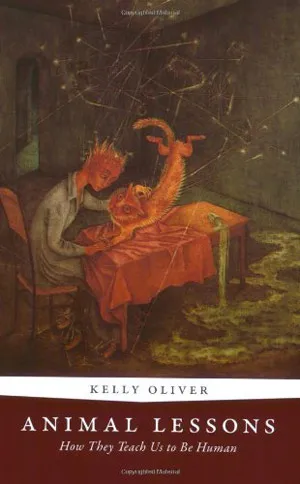
Animal Lessons
Kelly Oliver Animal Lessons: How They Teach Us to Be Human Columbia University Press376 pages, 9 x 6 inches ISBN 978 0231147279ISBN: 978 0231147262
Available here →January 19, 2010
20100119-oliver-kelly-on-animal-lessons-how-they-teach-us-be-human-3
A close-up
The rest of this thread

Kelly Oliver
Kelly Oliver is W. Alton Jones Professor of Philosophy at Vanderbilt University. She is the author of over seventy-five articles and nineteen books, including Women as Weapons of War: Iraq, Sex and the Media (2007), The Colonization of Psychic Space: A Psychoanalytic Theory of Oppression (2004), Noir Anxiety: Race, Sex, and Maternity in Film Noir (2002), Witnessing: Beyond Recognition (2001), Subjectivity Without Subjects: From Abject Fathers to Desiring Mothers (1998), and Family Values: Subjects Between Nature and Culture (1997). Her current book project is Knock Me Up, Knock Me Down: Images of Pregnancy in Hollywood Film and Popular Culture.
Pull this thread
The philosophers who insist most on the man/animal divide depend most heavily on animals for their arguments.
Know something the rest of us don't?
Most threads on Rorotoko begin with our invitation. Any thread can begin with a proposal: you write it with the same prompts every thread answers, and we review it.
Propose a thread →