
Kelly Oliver
Animal Lessons
Animal Lessons engages with, yet radically departs from, discussions of animal rights and animal welfare that dominate philosophical conversations about animals. I move away from the framework of animal rights because the history of this discourse and the notion of rights are bought at the expense of animals. We need to do more than merely expand our concept of rights to include some animals. Rather, we need to rethink what it means to be animal and what it means to be human.
We need to acknowledge how our conception of ourselves as superior to animals is dependent upon those very animals that we disavow. The concept of rights originated with property rights as people began to own and keep animals. They needed laws to insure that their “property” was protected, particularly because large animals needed space for grazing.
Property rights eventually spread into human rights, a notion that is also intimately related to, and dependent upon, animals. As we know, torture and genocide are usually justified by comparing the victims to animals who deserve such treatment. I argue that we need to explore why our conception of the animal or the beast justifies mistreatment. Our concern to rethink the animal and animality beyond debasement and abuse extends not only to animals, but also to humans who are treated “like animals.” What does it mean to “treat someone like an animal” or to “behave like an animal?”
Certainly, it is time to leave behind these archaic notions of animals as mere objects or beasts deserving the whip. I argue that only when we give up these ideas of animals as objects, or brutes, or our servants, or property, can we begin to treat other humans with dignity rather than relegate them to the subhuman category animal. In other words, our inhumanity to man is both physically and conceptually a direct result of our abuse of animals. My point is not to argue that in the end animals are like us.
Rather than look to qualities or capacities that make them the same or different from humans, I am interested in the relationship between the human and the animal, between humans and animals.
To insist, as animal rights and welfare advocates do, that our ethical obligations to animals are based on their similarities to us reinforces the type of humanism that leads to treating animals—and other people—as subordinates. Consideration of animals makes it more pressing than ever not to repeat exclusive gestures that justify our treatment of animals based on what we take to be salient about their nature or behavior.
Can we learn to appreciate animals for their differences from us and not just their similarities? If recent philosophies of difference are any indication we can acknowledge difference without acknowledging our dependence on animals, or without including animals in ethical considerations. We can talk about both identity and difference without examining the relationship between them.
What we need is to move from an ethics of sameness, through an ethics of difference, toward an ethics of relationality and responsivity. Animal ethics requires rethinking identity and difference, by focusing on relationships and response-ability. An ethics based on response-ability must acknowledge that all creatures on earth are blessed and cursed with the ability to respond. This project started as a work of mourning for my beloved companion of eighteen years, Kaos.
Friends sometimes warned me that I should quit thanking Kaos and Wizard in the acknowledgements of my books; they said that scholars would not take my writing seriously if I continued to thank my cats. Now, they are probably convinced that I have gone to the dogs (except those who know that I am a cat person). Recently, at a small symposium where I presented some ideas for the first chapter of this book, friends and strangers alike challenged my turn to animals; some of them even said that they had followed my work up to this point, but could not follow the animals.
Certainly, in the face of domestic violence, endless war, genocide, ethnic cleansing, racism, sexism, and all of the other forms of violence humans inflict on each other, the ethical treatment of animals seems secondary; indeed, focusing on animals in this context may seem unethical, a way of displacing the injustices inflicted on human beings and distracting us from the history of oppression, slavery and torture whose bloody reach continues to mar what we call humanity. It is legitimate to ask, why turn to animals at a time when our inhumanity to man continues unabated?
Yet, following animals through the history of philosophy, particularly recent philosophies of difference, has shown me that the practices of oppression, slavery, and torture are historically inseparable from the question of the animal. Tracking the animal through the writings of three centuries and more of philosophers has taught me that our concepts of man, humanity, and inhumanity are inherently bound up with the concepts of the animal, animality and animals. The man-animal binary is not just any opposition; it is the one used most often to justify violence, not only man’s violence to animals, but also man’s violence to other people deemed like animals.
Until we interrogate the history of this opposition with its exclusionary values, considering animals (or particular animals) like us or recognizing that we are also a species of animal does very little to change “how we eat the other,” as Jacques Derrida might say.
Editor: Erind Pajo
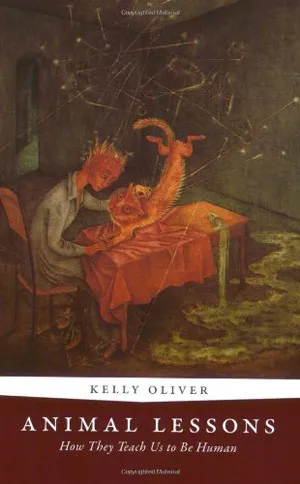
Animal Lessons
Kelly Oliver Animal Lessons: How They Teach Us to Be Human Columbia University Press 376 pages, 9 x 6 inches ISBN 978 0231147279 ISBN: 978 0231147262
Available here →January 19, 2010
20100119-oliver-kelly-on-animal-lessons-how-they-teach-us-be-human-2
The wide angle
The rest of this thread

Kelly Oliver
Kelly Oliver is W. Alton Jones Professor of Philosophy at Vanderbilt University. She is the author of over seventy-five articles and nineteen books, including Women as Weapons of War: Iraq, Sex and the Media (2007), The Colonization of Psychic Space: A Psychoanalytic Theory of Oppression (2004), Noir Anxiety: Race, Sex, and Maternity in Film Noir (2002), Witnessing: Beyond Recognition (2001), Subjectivity Without Subjects: From Abject Fathers to Desiring Mothers (1998), and Family Values: Subjects Between Nature and Culture (1997). Her current book project is Knock Me Up, Knock Me Down: Images of Pregnancy in Hollywood Film and Popular Culture.
Pull this thread
pulls againstpulls alongside
The philosophers who insist most on the man/animal divide depend most heavily on animals for their arguments.
Against JG · Story is what most sets humans apart, and fiction survived evolution because stories are flight simulators for social life. On: There is a difference in kind, not merely of degree, between human minds and animal minds
Against DS · The physics and neuroscience behind every musical style can be taught with grade-school arithmetic, and conservatories teach none of it. On: What we owe an animal follows from its capacities rather than from our relationship to it
Against ET · Gods were an incidental byproduct of brain evolution, born when autobiographical memory taught humans they would die. On: There is a difference in kind, not merely of degree, between human minds and animal minds
Against GF · No amount of humane handling justifies using animals at all, and veganism is the floor. On: What we owe an animal follows from its capacities rather than from our relationship to it
Alongside PL · Neanderthals could not produce the vowels that make speech clear, yet they talked, so language was no sudden human event. On: There is a difference in kind, not merely of degree, between human minds and animal minds
Alongside KR · Buying meat, eggs and dairy from small pastured farms is animal-centered even though the animals are killed. On: What we owe an animal follows from its capacities rather than from our relationship to it
Alongside AM · The traits we treat as definingly human are shared with birds, especially parrots and corvids. On: There is a difference in kind, not merely of degree, between human minds and animal minds
Alongside LS · Asking whether animal science is ethical misses its moral life, which shows in how lab workers talk about animals. On: What we owe an animal follows from its capacities rather than from our relationship to it
Know something the rest of us don't?
Most threads on Rorotoko begin with our invitation. Any thread can begin with a proposal: you write it with the same prompts every thread answers, and we review it.
Propose a thread →