
Trysh Travis
The Language of the Heart
I’ve got two of these. The first is on pages 16-17, where I talk about what this book is not. Unlike most of the writings on the topic, The Language of the Heart is neither “for” nor “against” recovery, and it’s important that people know that going in. Twelve-step groups like AA may work well for some people but not for others. The broader culture of recovery is in some ways insipid, banal, and politically reactionary, and in other ways profound, exciting, and progressive. Like any complex cultural phenomenon, recovery can’t be easily boiled down to a “good” or a “bad” thing, and people who come to the book expecting such blanket praise or condemnation will be disappointed.The second thing I hope a browsing reader would come across is the series of images on pages 89-91. These show the iconic figure that people in AA refer to as “the man on the bed,” the de-toxing drunkard being visited by sober AAs and encouraged to try their program of recovery. The first image is a staged photograph that accompanied the 1941 Saturday Evening Post article that first brought AA national attention; the second is an illustration for an article in the AA magazine The Grapevine. That illustration was translated into stained glass by AA members in Akron, Ohio in 2001, and the final image is of their work, which hangs in the Akron AA archives.This triptych of images is important to me for two reasons. The image of “the man on the bed” exemplifies both the vulnerability (represented by the man on the bed himself) and the mutuality (represented by the AAs who have come to offer him help) that together form the heart of 12-Step recovery. Mid-twentieth-century straight white masculinity did not value either of those traits particularly highly, and AA’s most radical feature may be its injunction to its members (about 66% of whom are men) to give up the habits of “domination and dependence” that have shaped their lives and their drinking. The man on the bed is poised to renounce those habits or to slip back into them, and so his image appears frequently in AA’s material culture. on sobriety medallions, bookmarks, murals, etc. That AAs continue to re-imagine the man on the bed in new media suggests that even as the organization has grown into a global phenomenon of millions of members, its radical potential— the possibility that individual men might transform their lives by embracing relationships of compassion, rather than competition—remains alive.Second, these images testify to the enormous help I received from recovering people while I was putting this book together. Few of my primary sources reside in standard repositories like libraries, museums, or professionally-maintained archives; instead, they came from private collections, offbeat literature dealers, and the archives maintained by recovering people interested in their own history. Their generosity in sharing these materials with me has been one of the greatest rewards of my research, and it is emblematized in these photos.One of the things I’ve become most aware of while working on this book is the degree to which cultural critics inside and outside of the academy write about phenomena that reflect and reinforce their own tastes and worldviews. There’s a lot of writing out there about addiction, because addiction, despite its tragic dimension, retains a sheen of cool. Drug and alcohol use and abuse are dis-inhibiting; they de-stabilize social norms. Without too much effort, we can see them as heroic challenges to the staid routines of our uptight bourgeois lives.Recovery culture, by contrast, is really square, both as aesthetics and as politics. One of the amateur authors I talk about drew inspiration from Lawrence Welk in many of his writings, for crying out loud—and not in an ironic way! It’s this squareness, I think, that has led critics to overlook the complexity of recovery—its existence as a cultural formation with a genuine intellectual and social history that both reflects and helps to construct the larger economic, political, and psychic realities around it.Personally, I would rather listen to hip-hop than to Lawrence Welk, and prefer reading high modernism to the personal stories in the Big Book. But that doesn’t mean that the culture of people whose tastes don’t run to transgressive or ironic texts is transparent or not worthy of scrutiny. Neither belletristic nor academic critics of the popular expend much energy on square cultures, however, except to occasionally talk about how awful they are. I wonder what other cultural formations besides recovery scholars of popular culture have simplified or overlooked in recent years simply because they don’t give us aesthetic or intellectual pleasure.
Editor: Erind Pajo
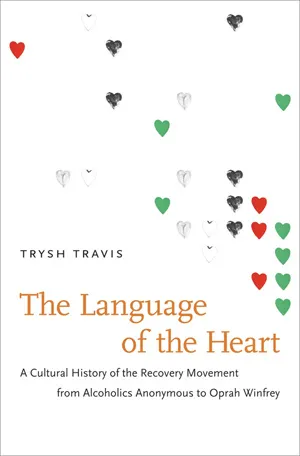
The Language of the Heart
Travis,Trysh The Language of the Heart: A Cultural History of the Recovery Movement from Alcoholics Anonymous to Oprah Winfrey University of North Carolina Press376 pages, 9 x 6 inches ISBN 978 0807833193
Available here →January 27, 2010
20100127-travis-trysh-language-heart-cultural-history-recovery-movement-3
A close-up
The rest of this thread

Joshua Lukman
Trysh Travis
Trysh Travis is an assistant professor in the Center for Women’s Studies and Gender Research at the University of Florida, where she teaches contemporary American literary and cultural history. Her writing has appeared in scholarly venues like American Quarterly and Men and Masculinities as well as in publications like The Chronicle of Higher Education and Bitch: Feminist Responses to Popular Culture.
Pull this thread
AA's most radical feature is its demand that men give up the habits of domination and dependence.
Know something the rest of us don't?
Most threads on Rorotoko begin with our invitation. Any thread can begin with a proposal: you write it with the same prompts every thread answers, and we review it.
Propose a thread →