
Robert E. Sullivan
Macaulay
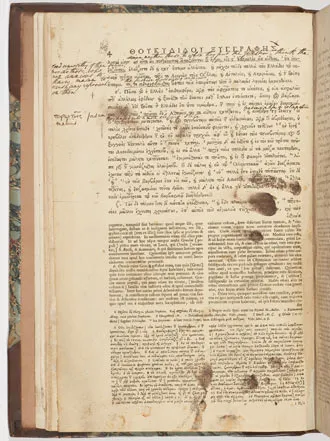
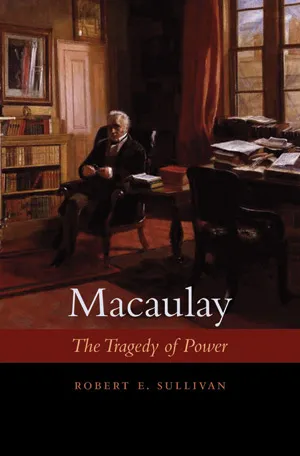
The introduction, the envoi, and two pictures may be worth several thousand words.The introduction surveys the book, and the envoi traces Macaulay’s impact to our times.The book’s dust jacket reproduces Edward Matthew Ward’s 1853 portrait of Macaulay in the National Portrait Gallery in London, an institution that Macaulay helped to invent. He sits comfortably in a well-appointed study, but the stacks of manuscripts on his writing table challenge the order of his bookshelves. Half of his face is shadowed. He is alone. Intimating that there’s more to Macaulay than meets the eye, Ward’s artistry captures the man’s mysterious doubleness, the need to conform and be accepted, as well as to simulate and dissimulate, which marked him from adolescence and helped to enable his success. It also captures Macaulay’s self-absorbed detachment from other people.Facing pages of Macaulay’s annotated copy of Thucydides’ History of the Peloponnesian War in Greek, preserved in a former country home of his distinguished collaterals, fill pages 142-143. During his Indian years Macaulay passed “the three or four hours before breakfast in reading Greek and Latin” and kept at it while being shaved. His numerous annotations in English, Latin, and Greek evidence his immersion in antiquity. The bloodstained, much-fingered pages testify to his impervious concentration rather than a shaky barber. Macaulay was a genius who lived mainly in his own mind.Should a reader be intrigued and her bookstore cappuccino still warm, she might scan pages 449-468 in the last chapter. It’s called “A Broken Heart.” The words are Macaulay’s and capture both his long-term depression and the cardiovascular disease that killed him. He was teary and food-addicted. Neither a psychiatrist nor a psychologist, I am unwilling to inflict incompetent theories on someone long dead. And so I let Lord Macaulay speak for himself at great length. My aim is to use his own record of himself, primarily in his letters and manuscript diaries to try to capture his sensibility, the patterns in his recorded perceptions and interactions that reveal how he saw and negotiated the world.Those pages are subtitled “The Sensibility of Power.” The condition and its consequences are inescapable human realities—I believe in original sin. At the end of 2008 while finishing the manuscript, I read Richard Holbrooke’s review of Gordon Goldstein’s Lessons in Disaster: McGeorge Bundy and the Path to War in Vietnam. Long ago in Saigon, Holbrooke, now our special representative for Afghanistan and Pakistan, encountered Bundy. After serving as a uniformed noncombatant during World War II, Bundy became self-confidently one of “the best and the brightest” and then an architect of the Vietnam War, hopelessly but unwittingly out of his depth. Holbrooke still blanched at Bundy’s encompassing emotional “detachment.” It fed on the deficient self-knowledge that enabled him to reduce groups and individuals to bloodless abstractions. To some extent, so must everyone who wields power over life and death. Imbued with the sensibility of power and brilliance, Macaulay was nearly complete and potentially lethal in his detachment.
Editor: Erind Pajo
Macaulay
Robert E. Sullivan Macaulay: The Tragedy of Power Belknap Press of Harvard University Press624 pages, 9 x 6 inches ISBN 978 0674036246
Available here →January 29, 2010
20100129-sullivan-robert-macaulay-tragedy-power-3
A close-up
The rest of this thread

Carol C. Bradley, U. of Notre Dame
Robert E. Sullivan
Robert E. Sullivan is Professor of History and Associate Vice President of the University of Notre Dame. He was educated at Harvard University (Ph.D., 1977). Before coming to Notre Dame in 1997, he taught there and then at Boston College, St. John’s Seminary (Boston), and the Weston Jesuit School of Theology (Cambridge). He is the author of John Toland and the Deist Controversy: A Study in Adaptations (1982) and has edited and contributed to books on history and higher education.
Pull this thread
Macaulay was the first responsible European publicly to advocate civilizing slaughter, and the silence about it was complicity.
Know something the rest of us don't?
Most threads on Rorotoko begin with our invitation. Any thread can begin with a proposal: you write it with the same prompts every thread answers, and we review it.
Propose a thread →