
Robert E. Sullivan
Macaulay
The interaction of modern religion and its surrogates interests me. It’s often misleadingly called “belief versus unbelief.” In fact, all of us believe a lot. For centuries intelligent people, both religious and non-religious, have been engaged in a conversation, sometimes become a mindless shouting match. Seven years ago I was trying to write a probably unwriteable book on how, between ca. 1800 and 1950, a confidently modern, religiously emancipated elite derived spiritual sustenance from the ancient Greek and Latin classics.
Because Macaulay was both an omnivorous classicist and an eminent post-Christian, I began reading his published works and letters in chronological order. A few pages into Sir William Temple (1838), much concerned with the classical mania of that seventeenth-century English diplomat and writer, he seems to digress on Oliver Cromwell’s invasion of Ireland in 1649. Macaulay misrepresents Cromwell’s slaughter of thousands of “aboriginal Irish” in wartime as a farsighted program of empire-building—regrettably never completed—and a model for later progressive, modernizing projects. Macaulay declares that, “it is in truth more merciful to extirpate a hundred thousand human beings at once, and to fill the void with a well-governed population, than to misgovern millions through a long succession of generations.”
The sentence was a thunder stroke. Far from being edgy satire or a lapse, Lord Macaulay’s endorsement of what I call “civilizing slaughter”—“genocide” and “ethnic cleansing” are twentieth-century words—was occasionally rephrased but never suppressed. His essay on Temple remained in print until 1974, and you can now read it as a Google Book. Nobody seems to have commented on its “luminous and terrifying” vision—perhaps even cared—until the 1990s, and then only in a couple of confused footnotes. Instead Macaulay was widely praised for championing “the rights of Jews, Roman Catholics, and Negroes.”
Macaulay explores what in his life and our culture made him both the first responsible European publicly to advocate civilizing slaughter and an icon into the second half of the twentieth century. The vast silence about his sinister prophecy during his lifetime and beyond resulted from indifference, acquiescence, and sometimes complicity.
Lord Macaulay dared to write and say publicly what many other respectable people in Europe and North America had previously dared only think or whisper. He was a cool realist, who understood that political power depends on violence or the threat of violence, inferred that in politics might and right are much the same thing, and upheld the English empire as the progressive engine of modern civilization.
By 1871 Charles Darwin, a humane man and fairly consistent liberal, restated what Macaulay helped to make conventional imperial wisdom as a law of evolutionary biology: “Extinction follows chiefly from the competition of tribe with tribe, and race with race . . . When civilized nations come into contact with barbarians the struggle is short, except where a deadly climate gives its aid to the native race.”
Until the day before yesterday and from both the Left and the Right, various luminaries have envisioned schemes of mass slaughter and the slaughter itself as driving the forward march of modern civilization. Friedrich Engels, Marx’s adjunct, was not alone in viewing history as “about the most cruel of all goddesses,” leading “her triumphal car over heaps of corpses.”
Editor: Erind Pajo
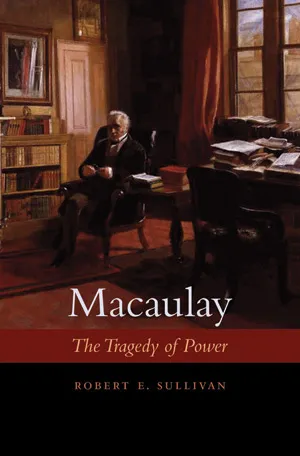
Macaulay
Robert E. Sullivan Macaulay: The Tragedy of Power Belknap Press of Harvard University Press 624 pages, 9 x 6 inches ISBN 978 0674036246
Available here →January 29, 2010
20100129-sullivan-robert-macaulay-tragedy-power-2
The wide angle
The rest of this thread

Carol C. Bradley, U. of Notre Dame
Robert E. Sullivan
Robert E. Sullivan is Professor of History and Associate Vice President of the University of Notre Dame. He was educated at Harvard University (Ph.D., 1977). Before coming to Notre Dame in 1997, he taught there and then at Boston College, St. John’s Seminary (Boston), and the Weston Jesuit School of Theology (Cambridge). He is the author of John Toland and the Deist Controversy: A Study in Adaptations (1982) and has edited and contributed to books on history and higher education.
Pull this thread
pulls againstpulls alongside
Macaulay was the first responsible European publicly to advocate civilizing slaughter, and the silence about it was complicity.
Against LR · Iraq's antiquities were pillaged for structural reasons, and most of the people involved acted in good faith. On: Moral evaluation of past actors belongs inside scholarly explanation of them
Against JS · The judgment of history is a fantasy, and history renders no verdict at all, only a record of contention. On: Moral evaluation of past actors belongs inside scholarly explanation of them
Alongside KF · Indigenous North America is a 20,000-year record of invention whose architecture stands comparison with medieval Europe's. On: Moral evaluation of past actors belongs inside scholarly explanation of them
Alongside AS · A social worker's finding of neglect is as factual as a doctor's reading of a blood-pressure number. On: Moral evaluation of past actors belongs inside scholarly explanation of them
Alongside AW · The German cameral sciences were fiscal propaganda written by men hunting salaries and promotions. On: Moral evaluation of past actors belongs inside scholarly explanation of them
Alongside FD · The Great Leap famine was mass murder, not miscalculation, and at least 45 million died. On: Moral evaluation of past actors belongs inside scholarly explanation of them
Nearby EH · Brontë's surviving garments are evidence of the same weight as her letters, novels and portraits.
Know something the rest of us don't?
Most threads on Rorotoko begin with our invitation. Any thread can begin with a proposal: you write it with the same prompts every thread answers, and we read it.
Propose a thread →