
Jonathan Walker
Pistols! Treason! Murder! The Rise and Fall of a Master Spy
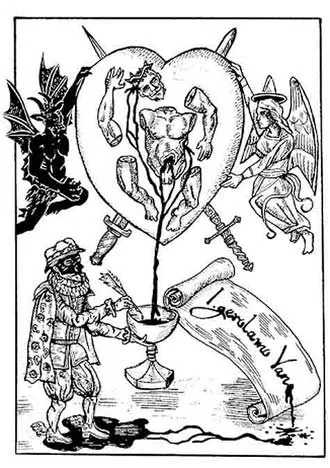
Pistols! Treason! Murder! contains numerous original illustrations, which I scripted and storyboarded, and which were created by Dan Hallett. The one reproduced here, titled The Wounds of Giulio Cazzari, accompanies the title chapter. It depicts in allegorical form the assassination of Giulio Cazzari, one of Vano’s numerous victims.Vano’s costume here is taken in part from that of the figure of “The Spy” in Cesare Ripa’s Iconologia, a ubiquitous visual source book of the period. Note the cloak of eyes and ears, and the winged boots of Hermes, messenger of the gods, who was also patron of “revelation, commerce, communication and thieving” (Vano’s activities fell under all four categories).
The cup is filled with ink, but obviously alludes to the Holy Grail, while the imagery as a whole also suggests the iconography of the wounds and sacred heart of Christ. However, in the context of the book, there is a more explicit reference to a passage from an earlier chapter, “Idiolect,” in which Vano’s words, read aloud, “taste like red wine—or, to be more precise, bad red wine: acidic, furring the tongue, lips and teeth; intoxicating, yet also prone to induce sore eyes and jabbing headaches. The more of them you speak, the more they numb the mouth and brain, and induce slurring.”Intoxication as a response to Vano’s words is a recurrent theme in the book, underlined elsewhere by another image in which I am shown drinking from the same cup into which Vano dips his pen here.In the image above, intoxication is further associated with a kind of knowledge based on vicarious participation in historical events through exemplary re-enactment, that is with the stigmata, and with holy communion, in which a Christian devotee respectively receives the wounds of Christ, or ingests the blood of Christ. But here the sacred meaning is violently profaned.
The secular grail that Vano holds aloft is therefore the elusive, unattainable goal of every historian’s quest: direct, unmediated access to the past. Finally, the disassembled corpse of Giulio Cazzari, the victim whose remains lie within the heart at the image’s apex, also alludes to the fragmentary nature of the sources recounting his death, which cannot be stitched together into a single, coherent narrative.To be absolutely clear, this image makes no claim to be a literal depiction of anything. Although it is composed of elements adapted from early modern sources, I have no idea what Vano or Cazzari looked like or wore. And while Cazzari certainly was assassinated as a result of Vano’s reports on his activities, his dead body was not in fact dismembered. This image is therefore a kind of diagram, one mapping arguments and elaborating subtexts rather than describing events.None of the ideas outlined in the discussion above are expressed directly in the text of the book. Such explanation would be redundant: the argument is all there in the illustration itself, and in its implied relation to other elements of the presentation, both visual and linguistic. So another of my arguments is, in effect, that we should take images seriously as independent vehicles for complex and abstract ideas.
The conventions of professional historiography require abstraction, restraint, and decorum. Gerolamo Vano has no place within this regime, just as he had no place within the official rhetoric of political culture in seventeenth-century Venice. Vano demands instead exemplification, excess, and vulgarity. By exemplification, I mean that the way the story is told becomes a commentary on its subject, so that the form of the presentation itself embodies the argument. By excess, I mean that the presentation borrows Vano’s contagious enthusiasm, and echoes his violent disregard of all conventional pieties. By vulgarity, I mean a willingness to cross the divide between high and low culture, a divide that Vano also ignored. Hence, allegorical comic strips; hence, three exclamation marks in the title; etc., etc. Several reviewers have responded to this approach with bafflement or irritation. Why can’t I just write a normal history book?
The point is that the normal protocols of interpretation do not work when applied to Vano’s reports; nor will his fragmentary story fit within the bounds of a conventional narrative.In response to these difficulties, we might simply conclude that the endeavour is impossible, and choose another subject. But an alternative course of action is to try to make the difficulties a compelling part of the story. When words fail, silence is not the only alternative. We can use pictures instead, or invite the participation of other voices through dialogue, or foreground gaps in the record by jump-cutting.Pistols! Treason! Murder! is not, therefore, just the story of Gerolamo Vano, a Venetian spy, although Vano is certainly a uniquely interesting individual; nor is it simply an attempt to place Vano within a particular historical context, although that context is certainly of unique importance. It is also an attempt to test the limits of historical representation, and to ask what happens if we deliberately transgress those limits.
Editor: Erind Pajo
Pistols! Treason! Murder! The Rise and Fall of a Master Spy
Jonathan Walker Pistols! Treason! Murder! The Rise and Fall of a Master Spy The Johns Hopkins University Press288 pages, 9 x 6 inches ISBN 978 0801893704
Available here →February 3, 2010
20100203-jonathan-walker-on-pistols-treason-murder-rise-fall-master-spy-3
A close-up
The rest of this thread

Scott Riley
Jonathan Walker
Jonathan Walker is a Senior Research Fellow in the Department of History at the University of Sydney. He is the author of articles on the history of Venice, which have appeared in journals such as Past and Present and Rethinking History. Pistols! Treason! Murder! is his first book. (The first chapter can be downloaded for free from http://www.pistolstreasonmurder.com; for more discussion see http://www.jonathanwalkersblog.com.) Together with Dan Hallett, Walker has just completed an “illuminated novel,” Five Wounds, which will be published by Allen & Unwin later in 2010. He is also working on a documentary photography project, Let Us Burn the Gondolas: Venice as a Modern City.
Pull this thread
The spy is the representative figure in the genealogy of modernity.
Know something the rest of us don't?
Most threads on Rorotoko begin with our invitation. Any thread can begin with a proposal: you write it with the same prompts every thread answers, and we review it.
Propose a thread →