
Stephen DeStefano
Coyote at the Kitchen Door
The preface provides a perspective for the book, as well as an explanation of the structure of each chapter, so that might be the appropriate place to start browsing.
The prologue (subtitled “Suburban Beginnings”) also helps set the stage for much of the writing. There I describe my first job as a biologist, working on the sub-arctic tundra of Cape Churchill, Manitoba and encountering a wide array of wildlife, including polar bears. Later in the prologue I introduce the coyote, and what the species means to our society and what it represents in terms of how we now view nature, and how nature continues to infiltrate our lives, independent and indifferent to our wants and desires.
The prologue also introduces the idea of the dichotomies that proliferate when the worlds of humans and wildlife merge. Although we tend to think of human and wildlife realms as separate, they are indeed one world; we share one planet.
I have been fortunate enough to experience the mysteries and beauties of nature in different biomes in the world, and I portray these in the introductory vignettes at the beginning of each chapter. These should give the reader a feel for that aspect of the writing. Although these opening narratives are connected in some way to the chapter, they could be considered stand-alone pieces. To me, all of the issues discussed in the book come down to our collective philosophies, feelings, and actions toward the land. Because our lives are so busy, our time is filled with so many gadgets, and we have grown accustomed to so many conveniences, I think it is easy to forget, or at least take for granted, the reliance we have on the land. So the last chapter, “A Suburban Land Ethic,” embodies probably the book’s most important message.
My ideas regarding the land come from Aldo Leopold’s writings, particularly Leopold’s essay “The Land Ethic” (in A Sand County Almanac). I think it is worth repeating today what Leopold advocated several decades ago.
The coyote is an important icon or symbol to our society, and to the societies in North America that came before us. For example, our relationship with predators like coyotes can be seen as emblematic or representative of our relationship will all of nature. This, in turn, leads to the theme of the dichotomies that we face in life and in nature, which appear often in the book: We cherish and fear nature; we preserve it yet exploit it; we try to live our lives sustainably and yet with such a profusion of consumer goods and services that we strain the ecological systems upon which we depend.
At times, my writing may have gotten almost too personal. I hope this will not be seen as self-indulgent but rather as an attempt to put our continuing struggle to understand our place in nature on personal terms. The issues I write about are not restricted to those who might call themselves environmentalists or conservationists—they are rather both a challenge and an opportunity for everyone in our society.
A friend who read the book thought that I may be too optimistic regarding our ability to understand our place in nature, formulate a land ethic, preserve open space and wildlife habitat, and live a more sustainable life. In the face of so many global crises, such as depleting oil reserves, climate change, an exponentially growing human population, and unending wars, it may be difficult to maintain a level of optimism. However, I have continually been amazed and impressed at the resourcefulness and ingenuity of people to seek and implement solutions. It is with that hope that I ended Coyote at the Kitchen Door.
Editor: Erind Pajo

Coyote at the Kitchen Door
Stephen DeStefano Coyote at the Kitchen Door: Living with Wildlife in Suburbia Harvard University Press 224 pages, 8 x 5 ½ inches ISBN 978 0674035560
Available here →February 5, 2010
20100205-stephen-destefano-on-coyote-kitchen-door-wildlife-suburbia-3
A close-up
The rest of this thread
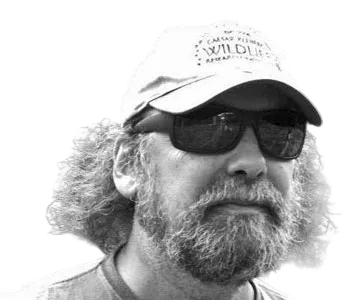
Stephen DeStefano
Stephen DeStefano is a Research Wildlife Biologist with the U. S. Geological Survey’s Cooperative Research Unit Program, and a Professor at the University of Massachusetts-Amherst. He has B.S., M.S., and Ph.D. degrees in Wildlife Biology from the Universities of Massachusetts, Wisconsin, and Idaho, respectively, and has served with Cooperative Research Units at Oregon State University and the University of Arizona. Stephen has worked on a variety of wildlife species and issues, including endangered species, forest wildlife, urban/suburban wildlife, and human-wildlife interactions. He is a board member of the Urban Wildlife Working Group of The Wildlife Society (TWS) of North America, a Fellow of TWS, and has several awards for research, service, and publications. He has produced over 100 academic papers and reports and co-authored two scientific books. Coyote at the Kitchen Door is his first book for the general reader.
Pull this thread
Suburbia is where the human-wildlife interface actually happens, and sprawl sorts wildlife rather than reducing it.
Know something the rest of us don't?
Most threads on Rorotoko begin with our invitation. Any thread can begin with a proposal: you write it with the same prompts every thread answers, and we review it.
Propose a thread →