
Pablo Piccato
The Tyranny of Opinion
Mexico emerged as a modern nation in the 1860s, after half a century of civil war, foreign invasion and political instability. In a new nation divided by ethnicity, class, religion and differing views of sovereignty, even the basic rules of political culture had to be sorted out. The right to speak in the name of public opinion was not automatically granted to a selected few, but was the object of constant debate. Who could speak or write in the name of Mexican society? What gave him, or her, the authority to do so? Historians have explored this struggle in terms of ideology (liberals against conservatives, republicans against monarchists) or class (the elite and the subaltern).
But honor was the category generally accepted, even across gender divides, as the foundation for the interactions among Mexican citizens, and between Mexico and other nations.
In Mexico, honor mutated drastically with the end of colonial domination. Whereas in the past honor was the visible marker of status and formalized the interactions between people divided by class, color and gender, after independence all Mexican citizens, regardless of color or ethnicity, had a rightful claim to honor. Honor was the point of reference to build a modern masculinity, it gave men the right to use reason publicly. This book looks at the first century of Mexican history as a simultaneous struggle to protect honor and empower public opinion.
Multiple press codes set out to guarantee, and at the same time limit, freedom of speech.
Honor and freedom of speech were intertwined because republican honor meant the intimate connection between one's reputation, its external dimension, and the inner domain of conscience and self-esteem. When a citizen spoke, it was tacitly accepted that he or she was speaking his or her mind. Without sincerity there could be no public debate. As a result, the limits to freedom of speech most commonly legislated were those intended to protect the honor of interlocutors.
Journalists, principal actors in my book, were sent to jail for libel more often than for inciting rebellion. Mexican newspapers, particularly since the 1860s, provided the field in which personal honor was tested and measured. Following romantic notions of sincerity and heroism, journalists challenged each others' reputations and defied men of power.
I examine other terrains as well: Mexico City streets, where parliamentarians, students and the plebs protested in 1884 against the negotiation of the debt with British bondholders; the personal disputes in bars, commerce, and tenement houses that drove people to sue each other for defamation or insults; the secretive, yet very public, field of honor, where elite men used the duel to solve their least treatable conflicts.
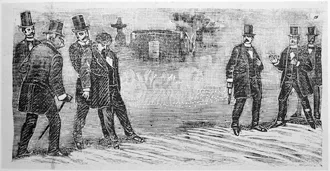
The Verástegui-Romero duel. Engraving by José Guadalupe Posada (no date). Reproduced in the book on page 230.
Editor: Erind Pajo

The Tyranny of Opinion
Pablo Piccato The Tyranny of Opinion: Honor in the Construction of the Mexican Public Sphere Duke University Press 400 pages ISBN 978 0822346456 ISBN 978 0822346531
Available here →February 10, 2010
20100210-pablo-piccato-on-tyranny-opinion-honor-construction-mexican-public-1-1
In a nutshell
The rest of this thread

Pablo Piccato
Pablo Piccato is associate professor at the Department of History and Director of the Institute of Latin American Studies at Columbia University. His research and teaching focus on crime, politics, and culture in modern Mexico. Besides The Tyranny of Opinion, featured in his Rorotoko book interview, Piccato is also the author of City of Suspects: Crime in Mexico City, 1900-1931 (Duke University Press 2001), and coeditor of True Stories of Crime in Modern Mexico (with Robert Buffington, 2009) and Actores, espacios y debates en la historia de la esfera pública en la ciudad de México (with Cristina Sacristán, 2005). He is currently working on the poet Salvador Díaz Mirón, and on Mexican civil society’s responses to crime.
Pull this thread
Honor, not ideology or class, decided who could speak for Mexican public opinion.
Know something the rest of us don't?
Most threads on Rorotoko begin with our invitation. Any thread can begin with a proposal: you write it with the same prompts every thread answers, and we review it.
Propose a thread →